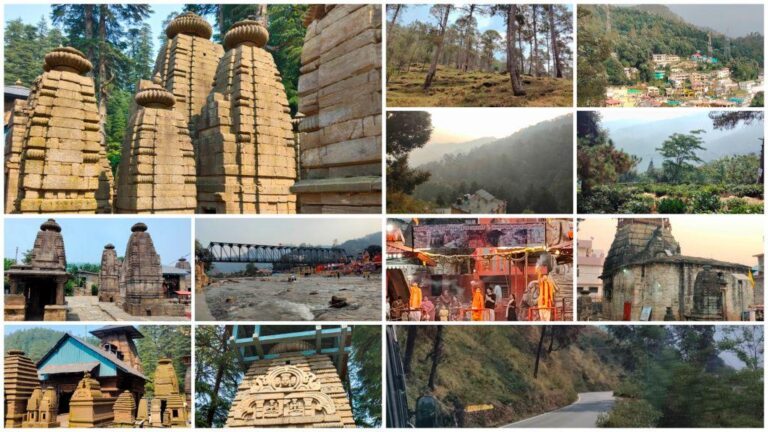
Budget Uttarakhand Solo Trip: Kausani, Baijnath, Bageshwar & Jageshwar in 3 Days
Can you explore the Kumaon Himalayas on a budget of just ₹4,000? Follow my three-day budget Uttarakhand solo trip from Rudrapur to Kausani, Baijnath, Bageshwar and Jageshwar using trains, buses and shared taxis, complete with costs, itinerary and practical travel tips.
As part of my yearly resolve to explore my home state, Uttarakhand, I decided in the summer of 2026 to travel through a quieter and deeply meaningful part of Kumaon – covering Kausani, Baijnath, Bageshwar and Jageshwar.
This was not just another hill trip; it was a journey into a region where Himalayan landscapes, ancient temples and river valleys come together beautifully.
Iterenary
I selected these places because each one offered a different reason to travel deeper into Kumaon. Kausani attracted me for its famous panoramic views of the Himalayan peaks. Baijnath appealed to me because of its ancient Katyuri-era stone temples on the banks of the Gomti River. Bageshwar was worth including as it is a town known for its temples, local markets, and the sacred confluence of rivers. Jageshwar completed the circuit with its famous cluster of old Shiva temples set amid dense deodar forest. Together, these destinations gave me exactly what I was looking for – a short, economical journey that combined Himalayan views, history, temples, local culture and the quiet charm of Kumaon.
Since I was working remotely during my visit to my hometown, I made the most of the opportunity by taking a day’s leave on Friday and combining it with the weekend. That gave me the perfect three-day break to explore the Kumaon hills without taking an extended vacation to explore some of Kumaon’s most fascinating destinations using only the most economical modes of transport available.
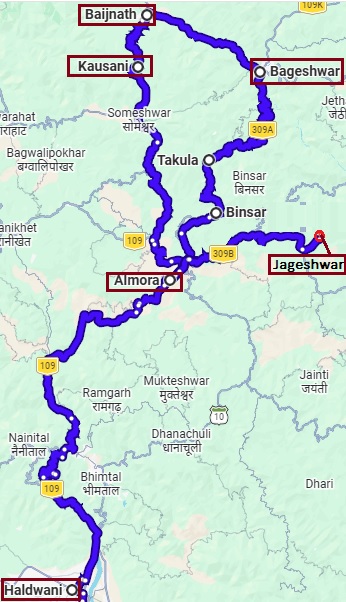
The route I planned was both scenic and spiritually enriching: Rudrapur >> Haldwani >> Almora >> Kausani >> Baijnath >> Bageshwar >> Almora >> Jageshwar >> Almora >> Haldwani >> Rudrapur
Day 1: A Scenic Journey from Rudrapur to Kausani
An Early Morning Start from Rudrapur
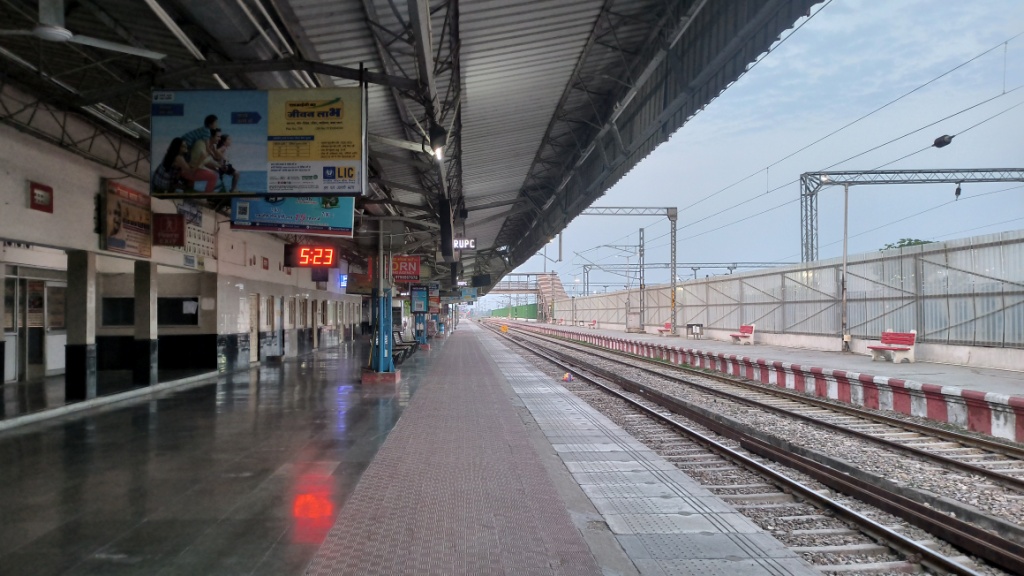
Rudrapur Station
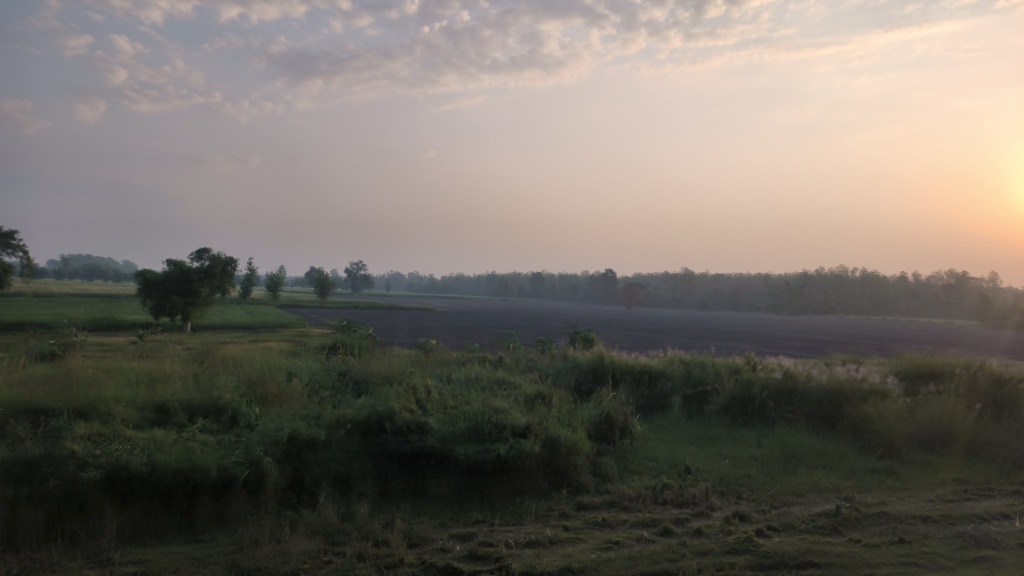
Morning view from the train
The first day of my solo trip began before sunrise. From Rudrapur City station, I boarded the Dehradun–Kathgodam Express (Train No. 14120) at 5:30 AM.
I reached Haldwani Railway Station by 7:00 AM after a comfortable 1.5-hour journey. The train ticket cost only ₹35, proving once again that trains remains one of the most economical ways to travel. After getting down at the station, I walked for about 15 minutes to the Haldwani bus stand. The morning air was fresh, and the town was just beginning to wake up.
Bus Journey to Kausani via Almora
Bus to Kausani
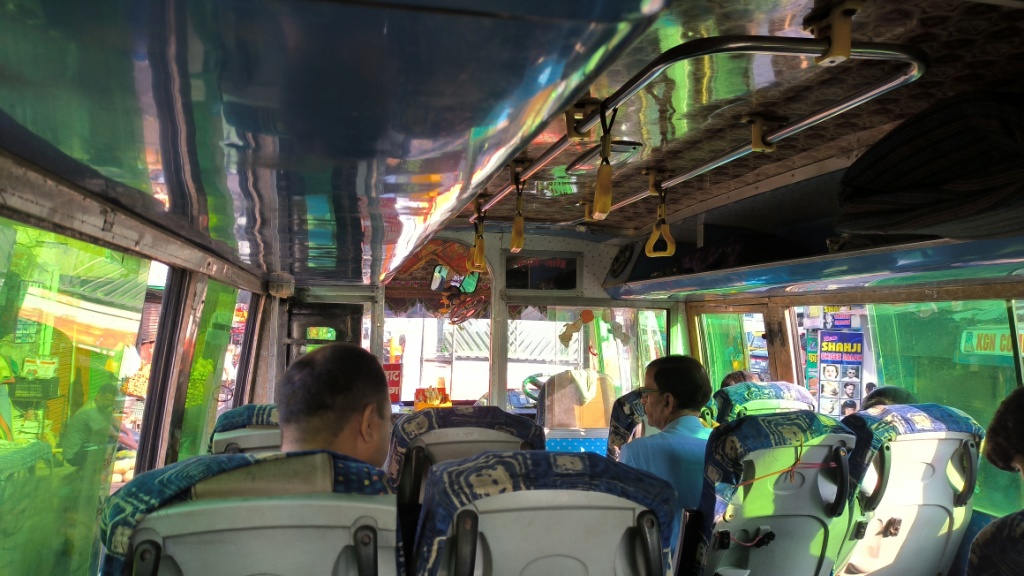
From the bus stand, I boarded a bus bound for Bageshwar, which follows the scenic Bhowali-Almora route. Since Kausani lies on the same route, it was the perfect choice for reaching my destination. The bus ticket cost ₹310. Like many hill buses, it did not depart on schedule. Instead, it waited until every seat was occupied before finally starting the journey.
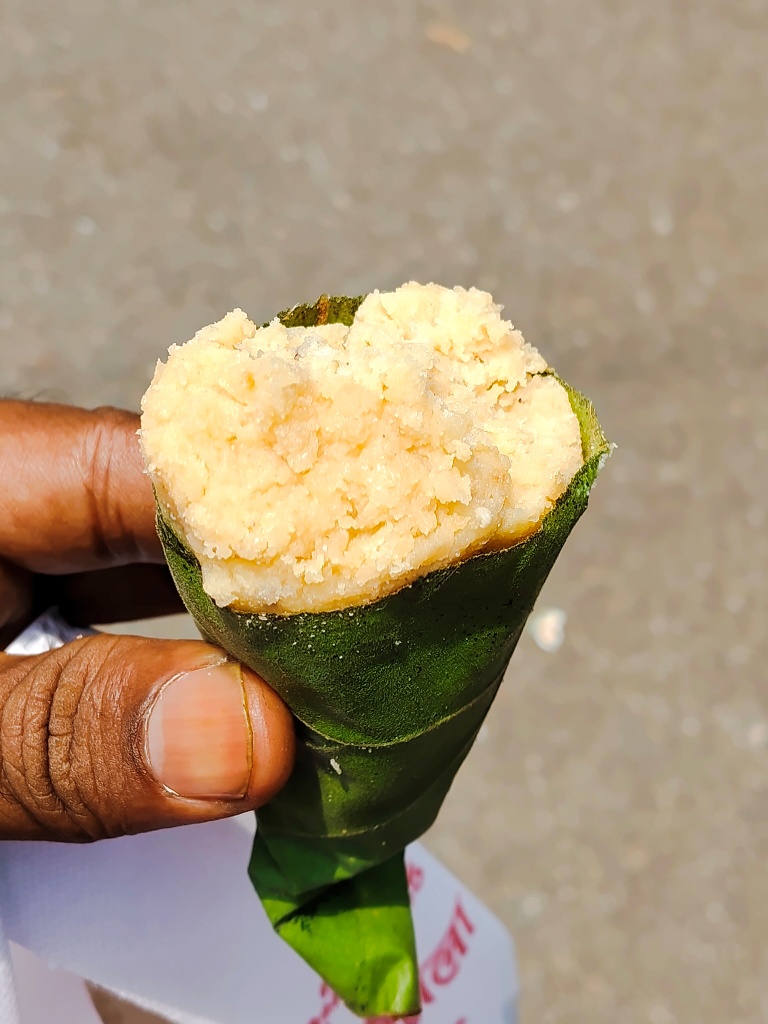
At around 11:30 AM, the bus reached Almora, where it halted for nearly 30 minutes. I used the break to have lunch before continuing towards Kausani. No visit to Almora feels complete without visiting the famous sweet shop – ‘Kheem Singh Mohan Singh Rautela’.
I had visited this shop during my last year trip to Almora. Wrapped in a fragrant malu leaf, this traditional Kumaoni delicacy was the perfect dessert before resuming the journey. I also bought some ‘Bal Mithai’ to bring it back home.
Singauri
Kosi River
Someshwar
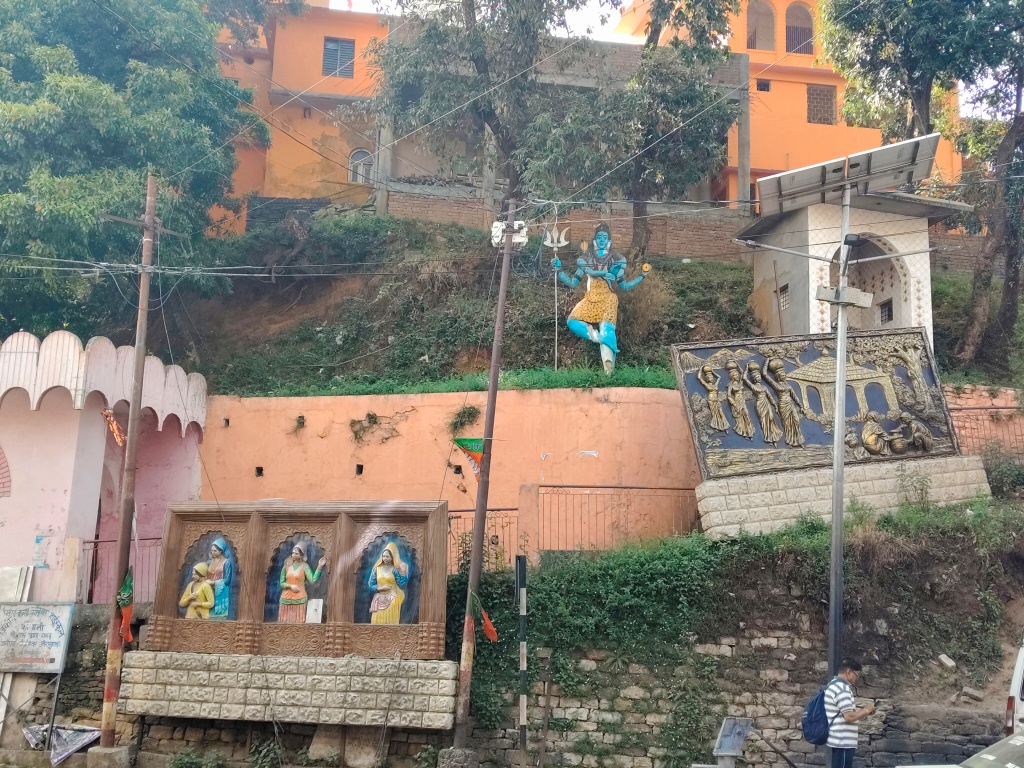
Arriving in Kausani
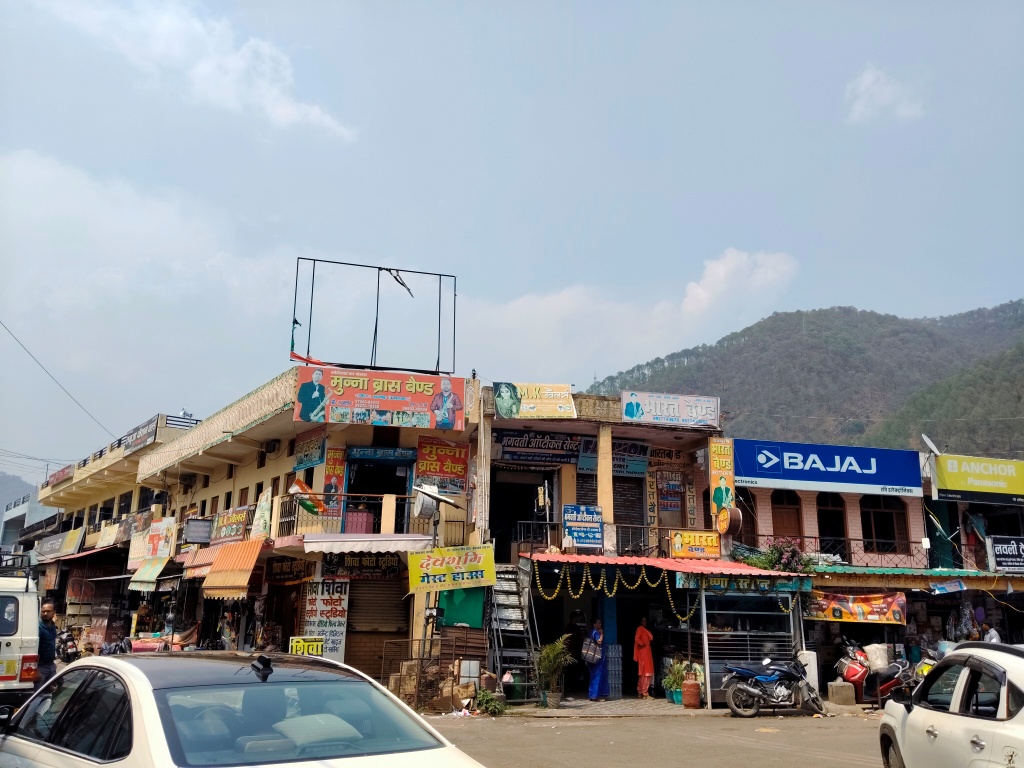
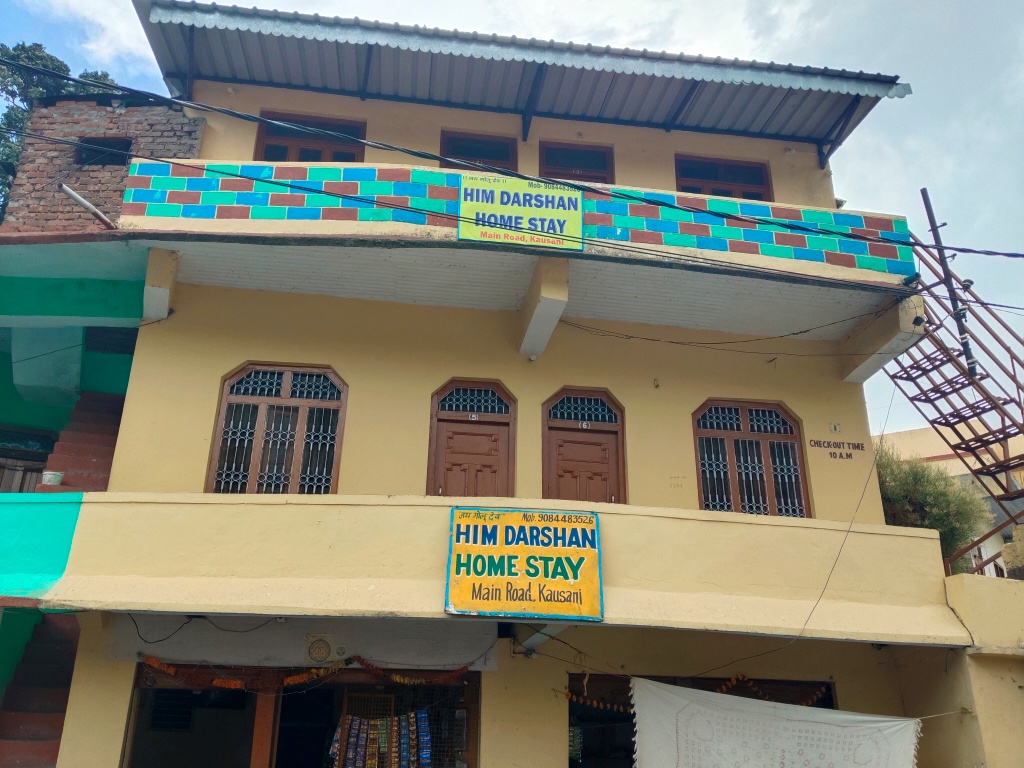
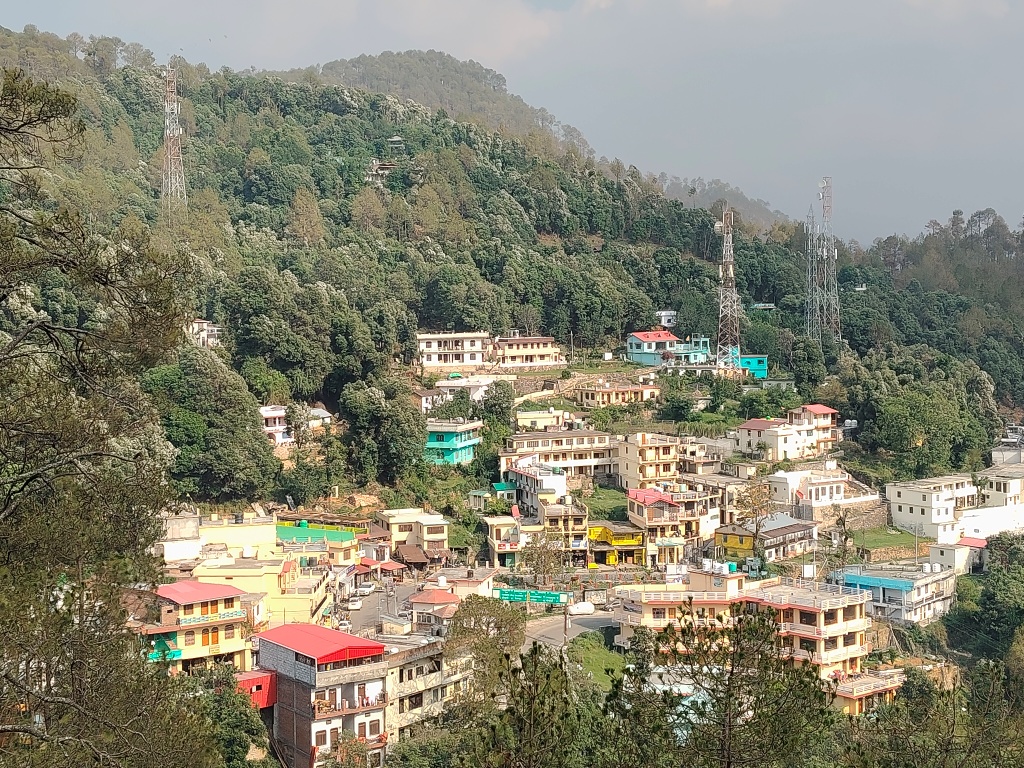
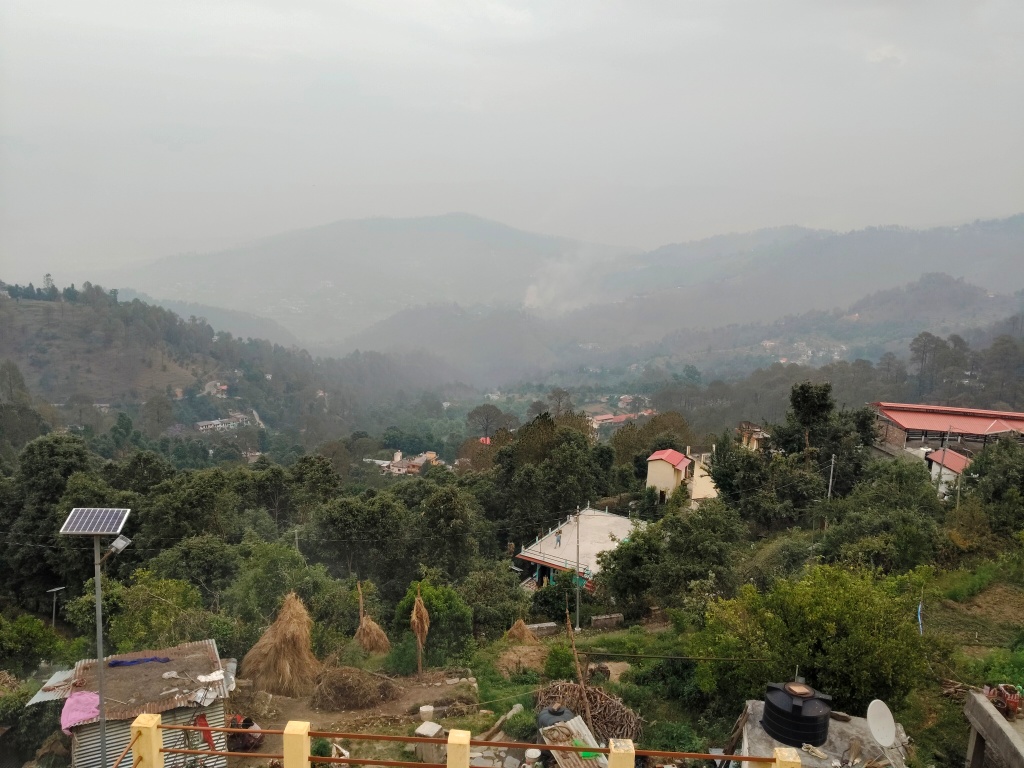
At around 3:30 PM, I finally arrived at Kausani, often called the “Switzerland of India” because of its panoramic Himalayan views. Since I was travelling on a strict budget of ₹4,000, my first priority was to find an affordable place to stay. Just a few steps from the bus stop, I found Him Darshan Homestay. The room cost ₹600 for the night.
Kausani Bus Stop
Him Darshan Homestay
The room itself was fairly average, but its location made it an excellent choice. It stood right on the main market road, with the bus stop literally a stone’s throw away. That meant I could easily continue my journey the next morning without worrying about transportation.
One small inconvenience was the lack of hot water. The homestay provided hot water only on request, charging ₹60 per bucket. After dropping my backpack in the room, I headed out immediately to explore Kausani before sunset.
Exploring the Birthplace of Sumitranandan Pant
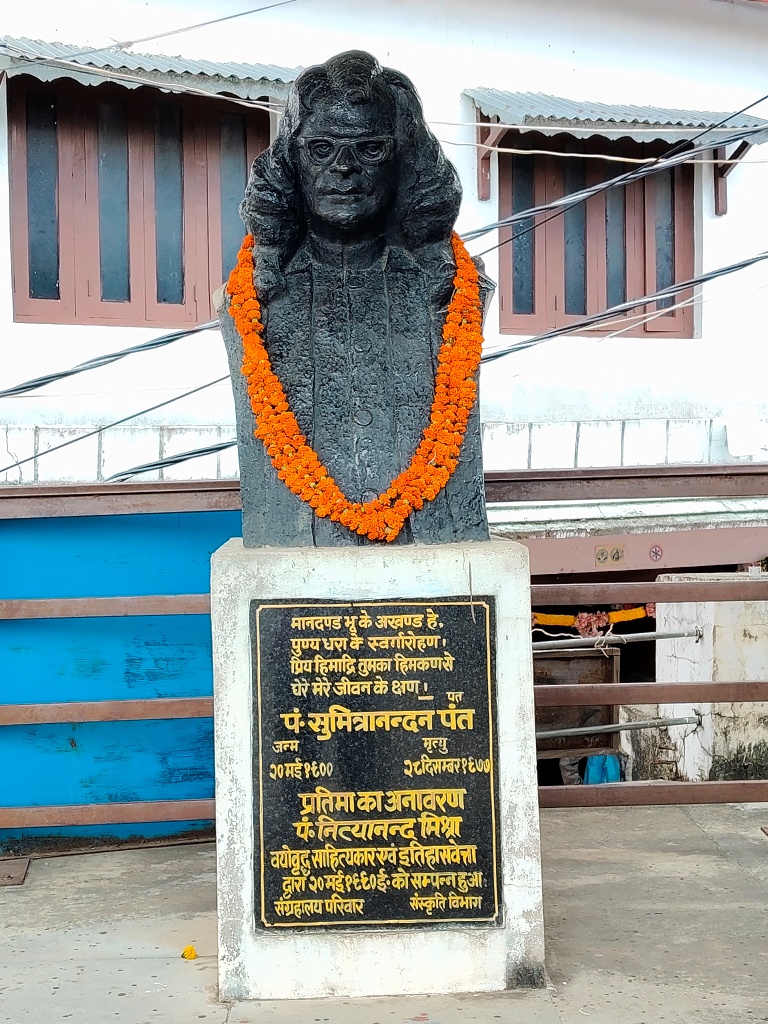
Sumitranandan Pant
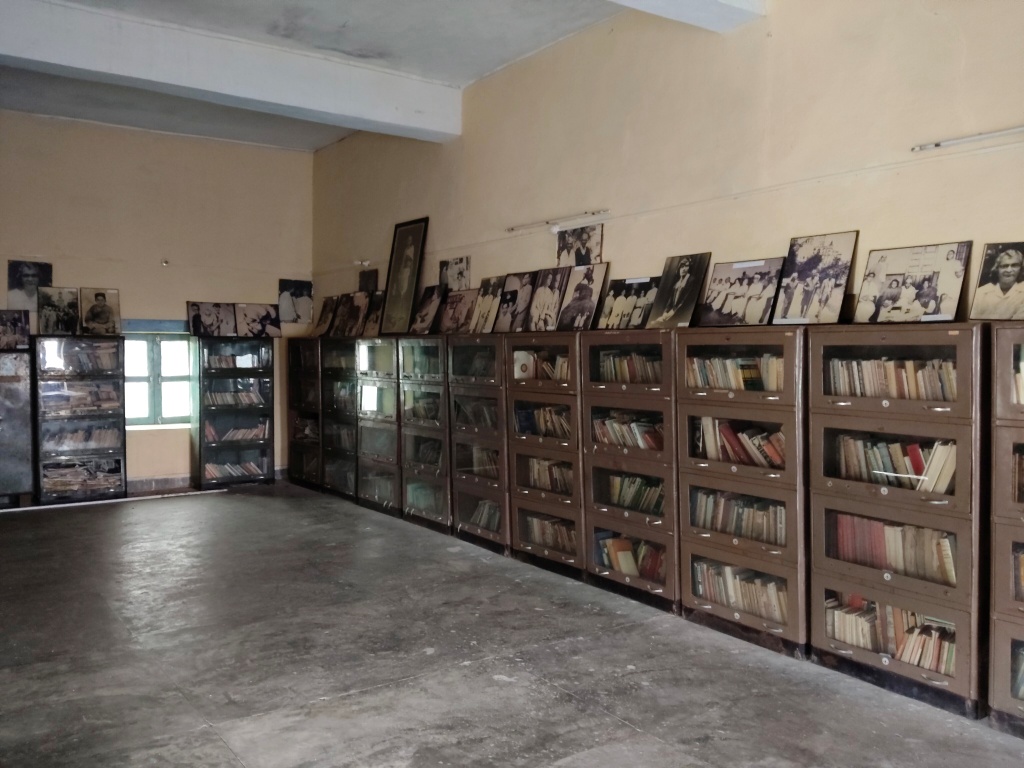
My first stop was the Sumitranandan Pant Museum. The easiest way to reach the museum is by taking the staircase that begins near the main bus stop in the market. Since the museum closes around 5:00 PM, I decided to visit it as the first thing after checking in.
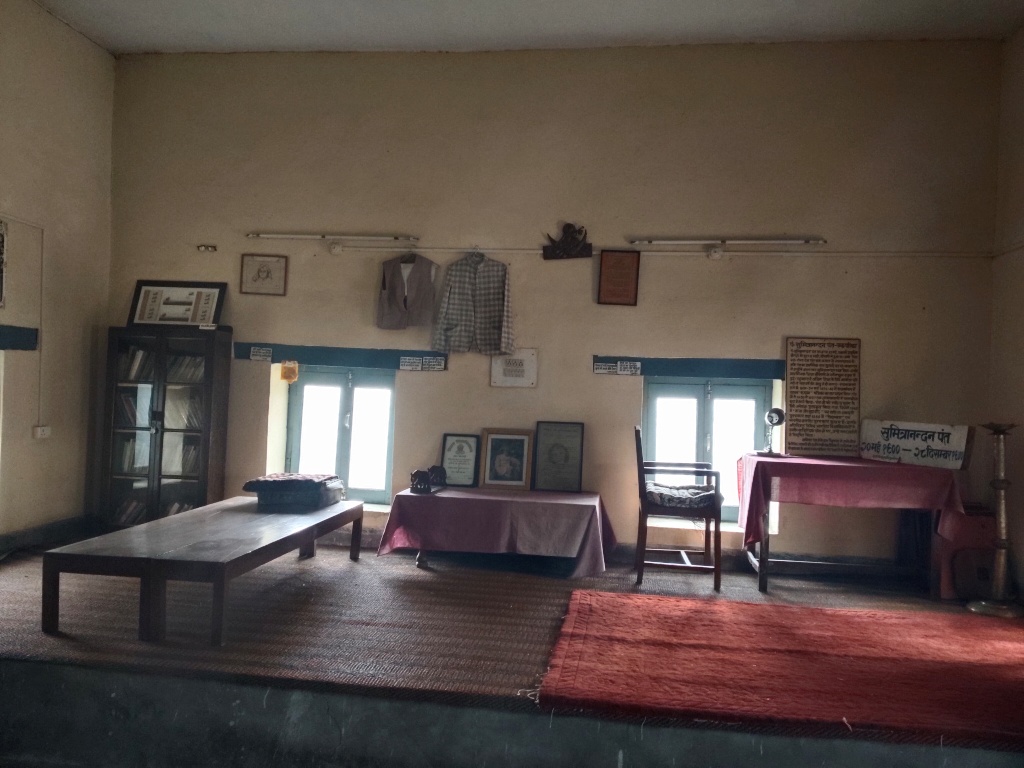
The museum is dedicated to the renowned Hindi poet Sumitranandan Pant and displays his original manuscripts, personal letters and belongings. It also has a library containing his personal collections of books. During my visit, the house where he was born was undergoing renovation. The entry ticket cost only ₹10, making it an inexpensive yet worthwhile stop for literature lovers
Sumitranandan Pant Museum
Walking to the Peaceful Anasakti Ashram
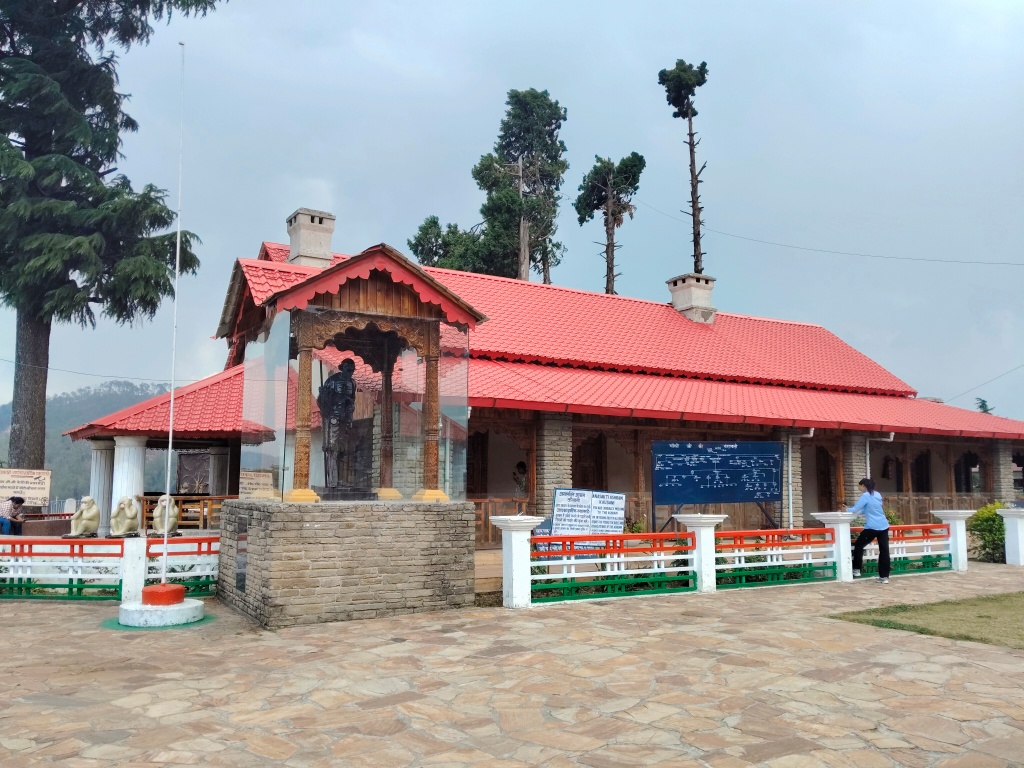
Only about 10 minutes on foot from the museum lies the serene Anasakti Ashram. The ashram holds special historical importance because Mahatma Gandhi stayed here in 1929. Mesmerized by the Himalayan landscape, he wrote Anasakti Yoga during his stay. The prayer hall, library and museum together create a calm atmosphere that encourages visitors to slow down and appreciate the surroundings. The ashram remains open until 6:00 PM, and the entry fee is ₹25.
Anasakti Ashram
Views from Anasakti Ashram
Evening Walk and Dinner at the Kausani Market
As daylight slowly faded, I spent some time strolling through the local market. The small market is known for its handwoven Kausani shawls, locally produced honey, and Kausani tea leaves, all of which make excellent souvenirs for visitors.
Kausani Town
To stay within my budget, I chose a nearby local dhaba for dinner and enjoyed a simple vegetarian thali costing just ₹120. Life in the hills winds down much earlier than in the plains. By around 8:00 PM, most of the shops had already started pulling down their shutters. With an exciting second day ahead, I returned to my room and called it a day.
Day 2: Kausani to Baijnath and Bageshwar - Tea Gardens & Ancient Temples
After an eventful first day in Kausani, I woke up early, excited for another day of exploring Kumaon. The plan was simple but ambitious – visit the famous Kausani Tea Estate, explore the historic Baijnath Temple, and finally reach Bageshwar, where I would spend the night.
A Chilling Start to the Morning
Kausani sits at an altitude of nearly 1,900 metres, and the morning temperature was around 14°C. After freshening up, I decided it was time for a bath. Only then did I realise how cold the water actually was. I searched for the property manager so that I could request a bucket of hot water, but he was nowhere to be found.
Left with no other option, I gathered some courage and took a cold-water bath. The icy water sent chills through my entire body. It was probably one of the coldest baths I have ever taken, but it certainly woke me up better than a hot cup of tea could have.
Breakfast with Himalayan Views
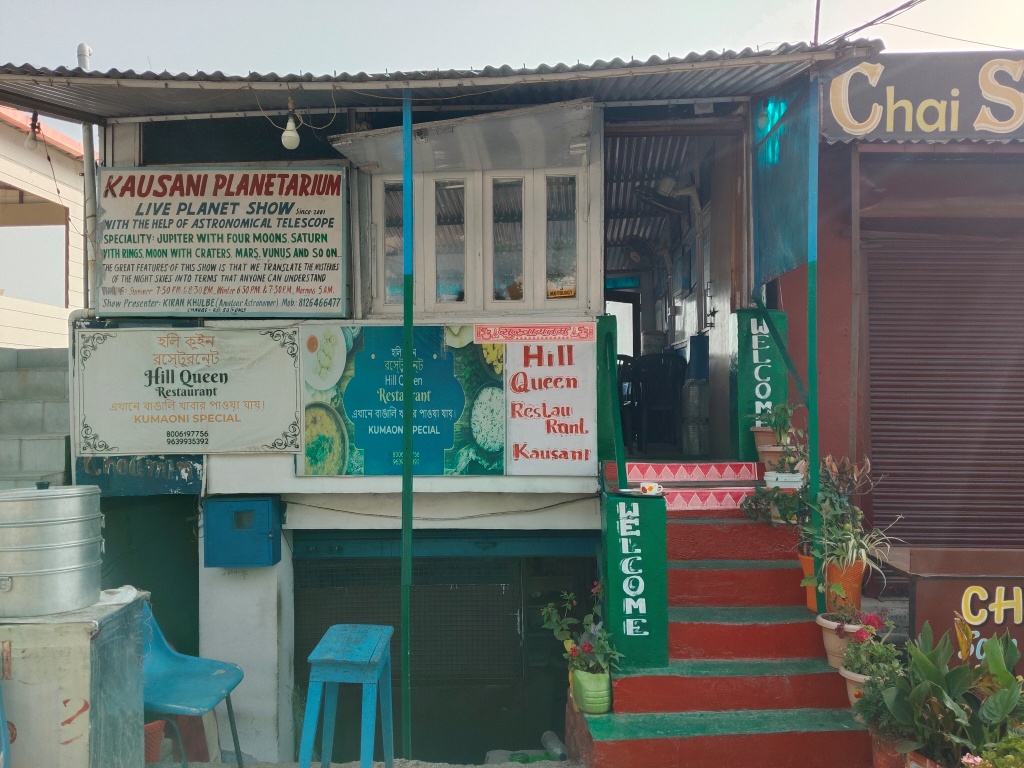
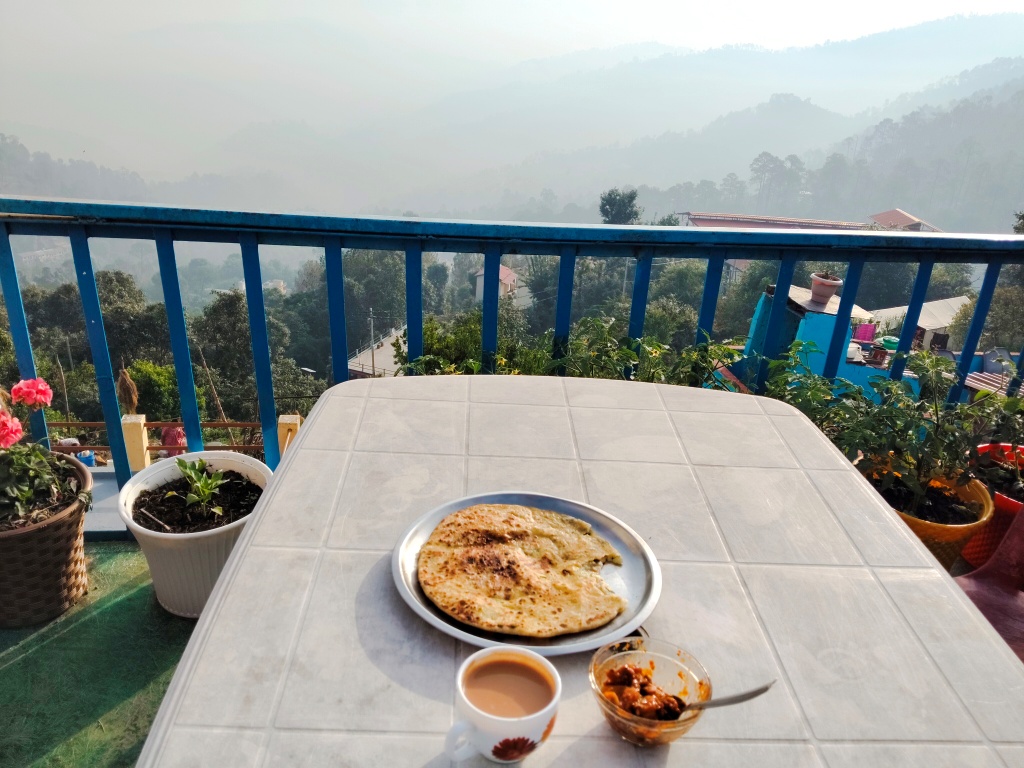
After getting ready, I walked towards Anasakti Ashram in search of breakfast. On the way, I came across a small restaurant called Hill Queen Restaurant. The restaurant itself was modest, but its greatest attraction was the seating area overlooking the mighty Himalayas. It was one of those places where the view becomes an essential part of the meal. I ordered aloo parathas along with a cup of traditional Kumaoni chai. The breakfast cost ₹140.
Hill Queen Restaurant
Breakfast
Instead of rushing, I spent nearly an hour simply enjoying the peaceful atmosphere. The early morning sunshine, the cool mountain breeze and the snow-clad Himalayan peaks combined to create a wonderfully relaxing start to the day. Sometimes, slow travel offers experiences that no sightseeing itinerary can.
Visiting the Kausani Tea Estate
With breakfast complete, I checked out from the home stay and headed towards the bus stop to continue my next destination – Kausani Tea Estate which lies just about 5 kilometres from Kausani. Since I had enough time before travelling further, I decided not to miss it. A shared taxi dropped me at the estate for just ₹20.
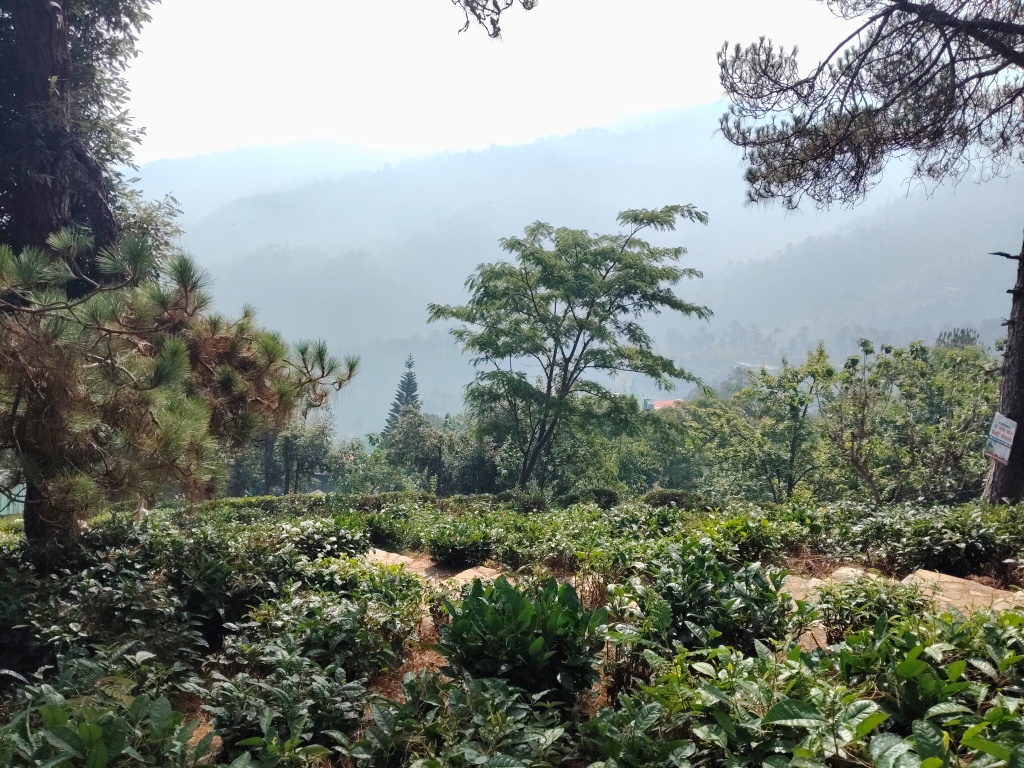
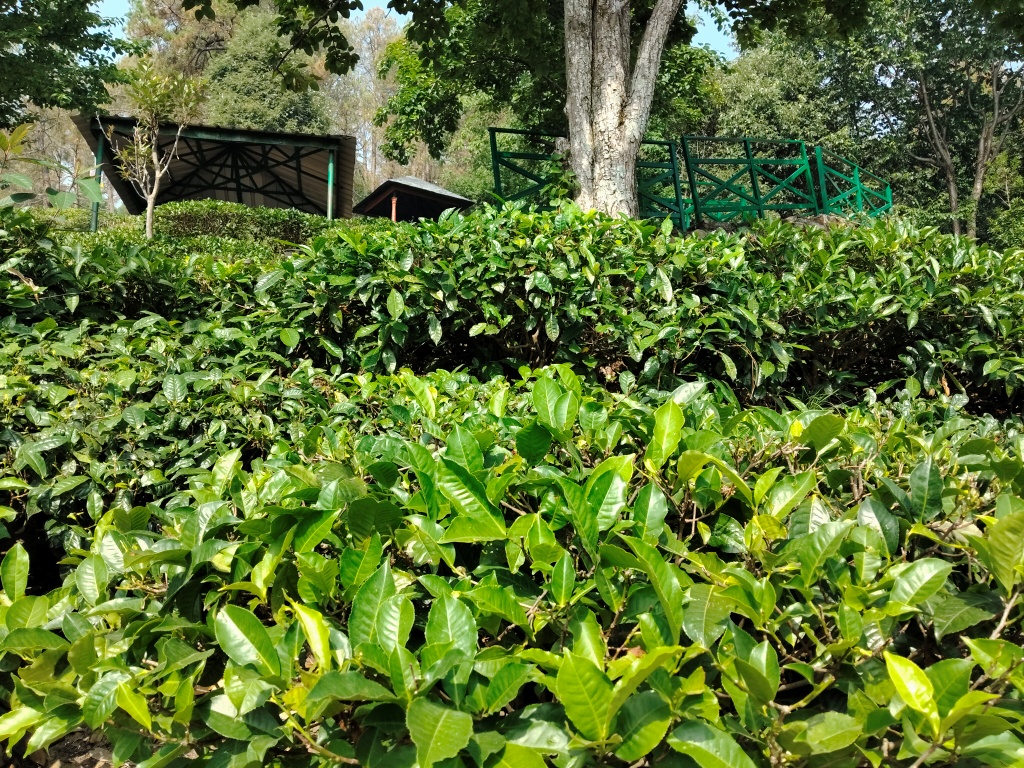
The day being the second Saturday, the tea factory remained closed for the day. Although I couldn’t witness the tea processing, visitors were still allowed inside the sprawling tea gardens after purchasing an entry ticket of ₹25. That turned out to be more than enough reason to visit.
I slowly walked through the neatly arranged rows of tea bushes, making my way towards the far end of the plantation. The peaceful surroundings, clean mountain air and gentle silence made the stroll incredibly refreshing.
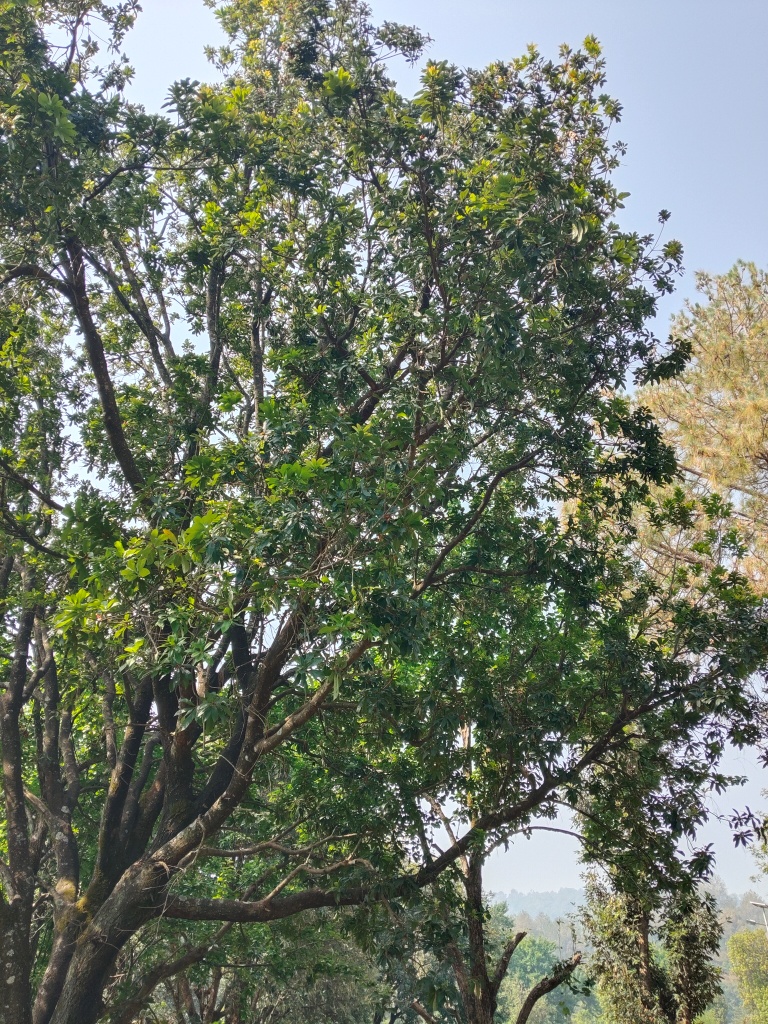
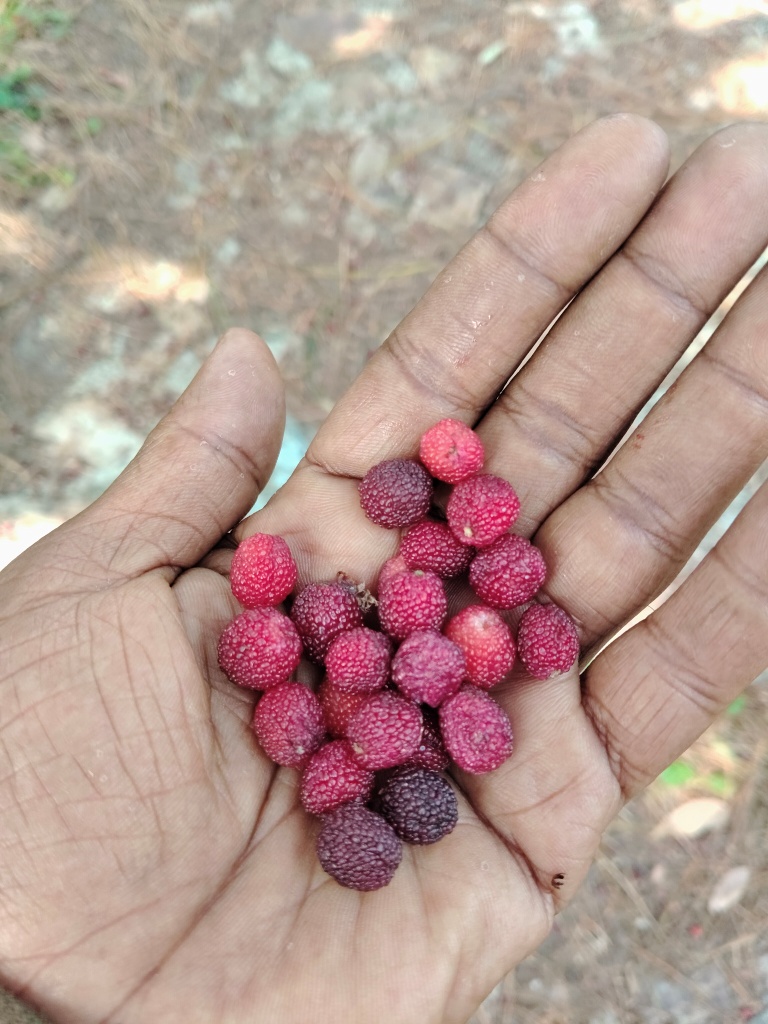
One pleasant surprise during the walk through the plantations was spotting a Kafal tree, one of Uttarakhand’s most beloved seasonal fruit trees. Kafal grows naturally in the Himalayan region and becomes available during the summer months.
Kafal tree
Kafal
Green Tea
After completing the long walk through the estate, I stopped at the garden-side café. There, I enjoyed a freshly brewed cup of locally produced green tea, prepared using tea grown in the same plantation.
Shared Taxi to Baijnath
After spending a relaxing morning at the tea estate, it was time to move towards my next destination. Another shared taxi took me to Baijnath for ₹70.
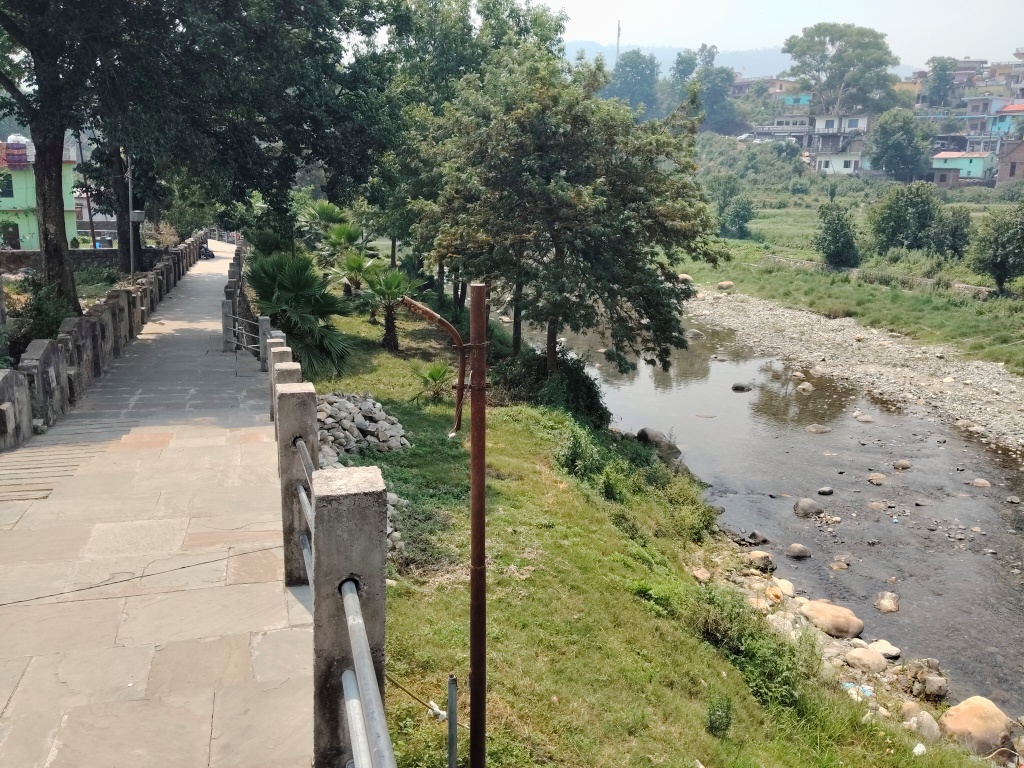
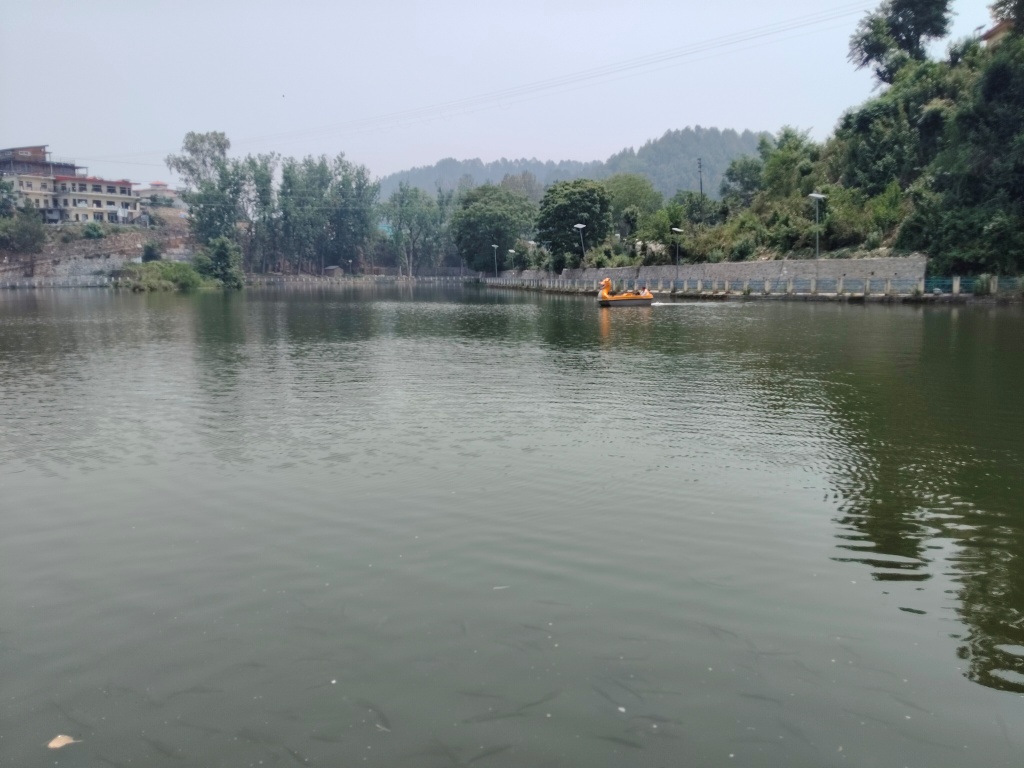
The route passed through the important Kumaoni town of Garur, and after about 30 minutes, I arrived near the famous Baijnath Temple. The drop point lies on the Baijnath – Bageshwar Road, from where the temple complex is only a short walk away. A quiet pathway runs alongside the Gomti River, which forms Baijnath Lake adjacent to the group of temples.
Way to Baijnath temples
Baijnath Lake
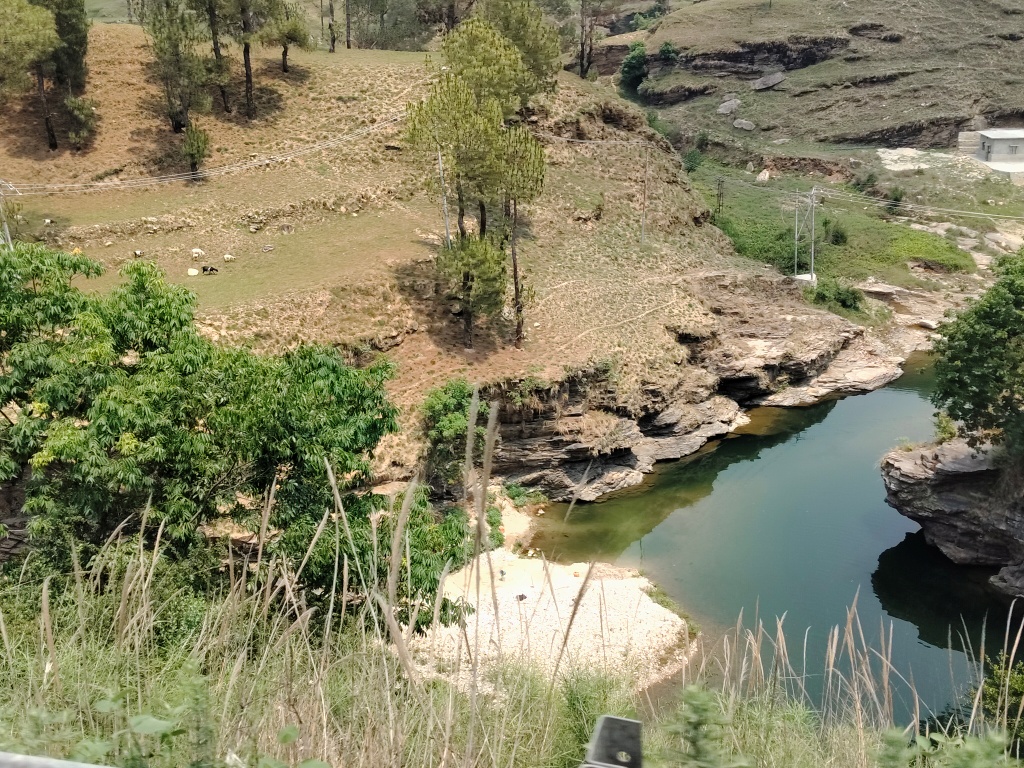
Interestingly, this is not the same Gomti River that flows through Uttar Pradesh. The Kumaon Gomti River originates from Gomat Taal in the Kumaon Himalayas. From there, it flows through Baijnath and Bageshwar, before finally merging with the Saryu River near Bagnath Temple. The better-known Gomti River of UP, on the other hand, originates in Pilibhit, flows through cities like Lucknow and Jaunpur, and eventually joins the Ganga near Ghazipur.
Baijnath Temple - A Jewel of the Katyuri Dynasty
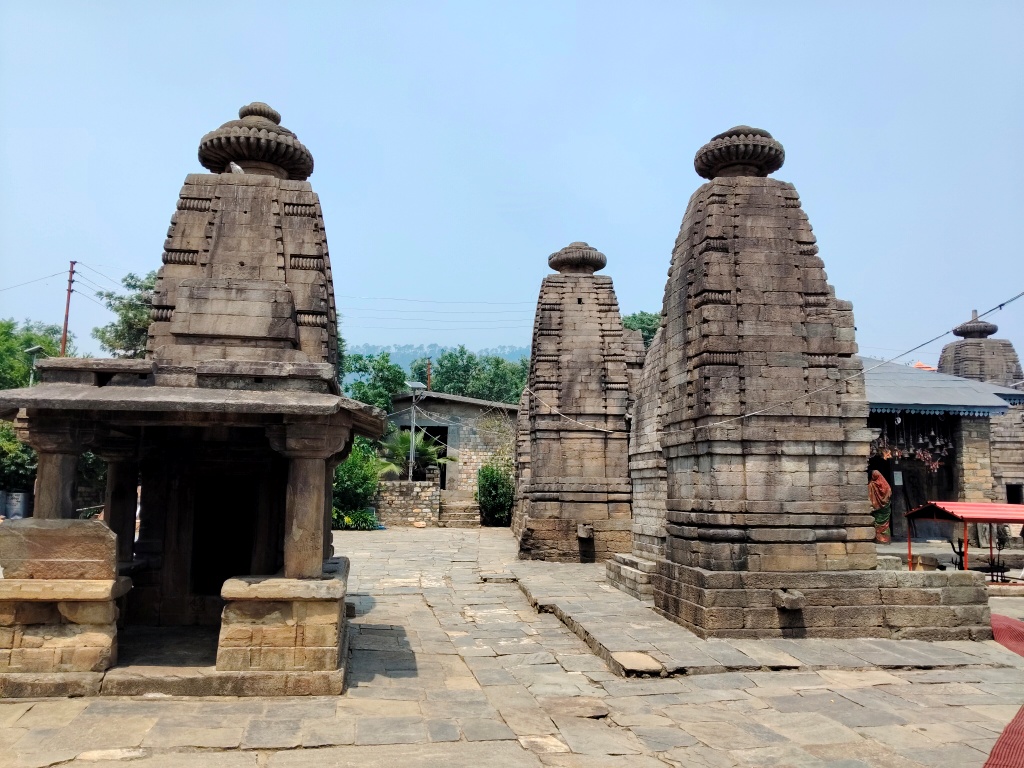
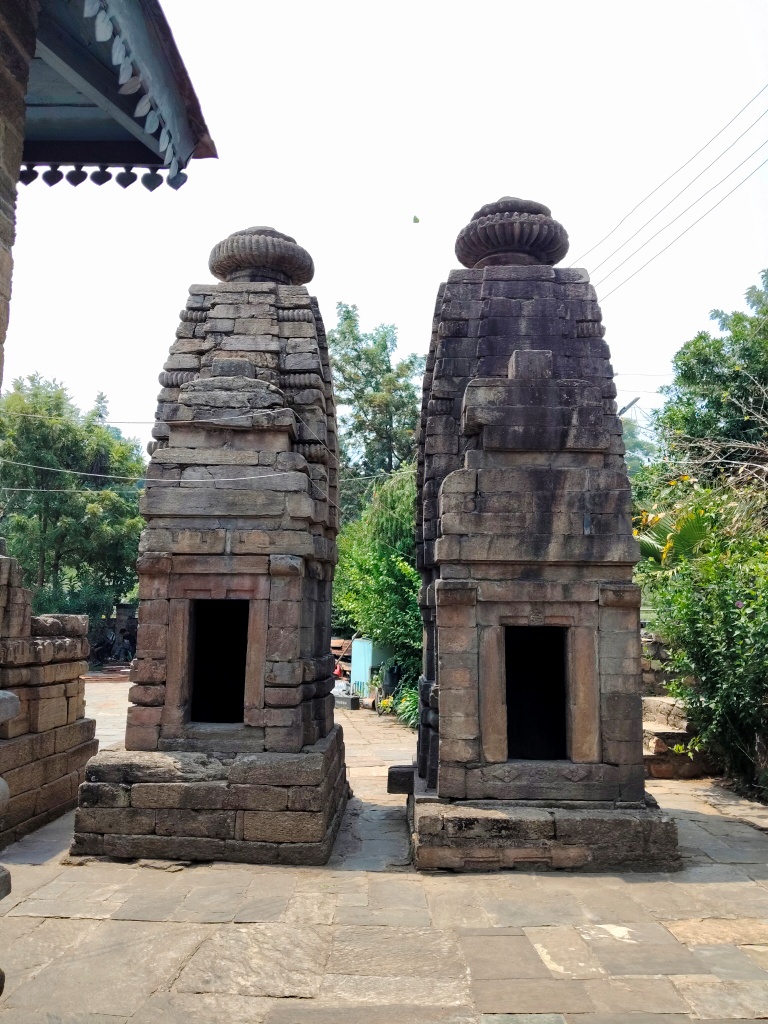
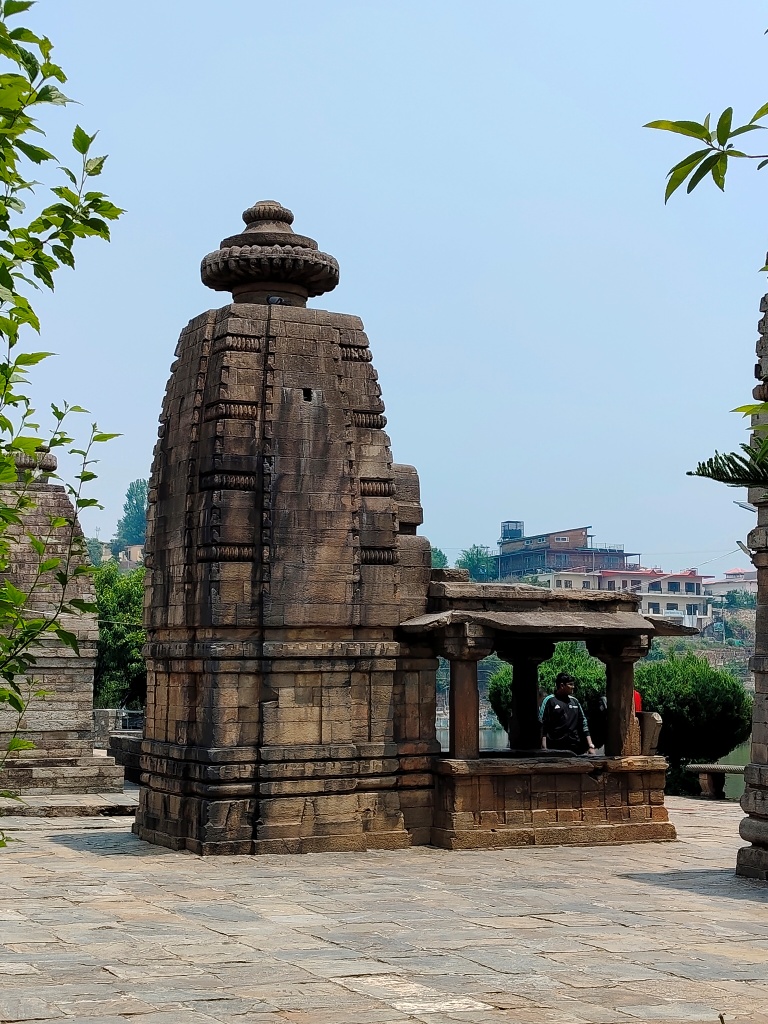
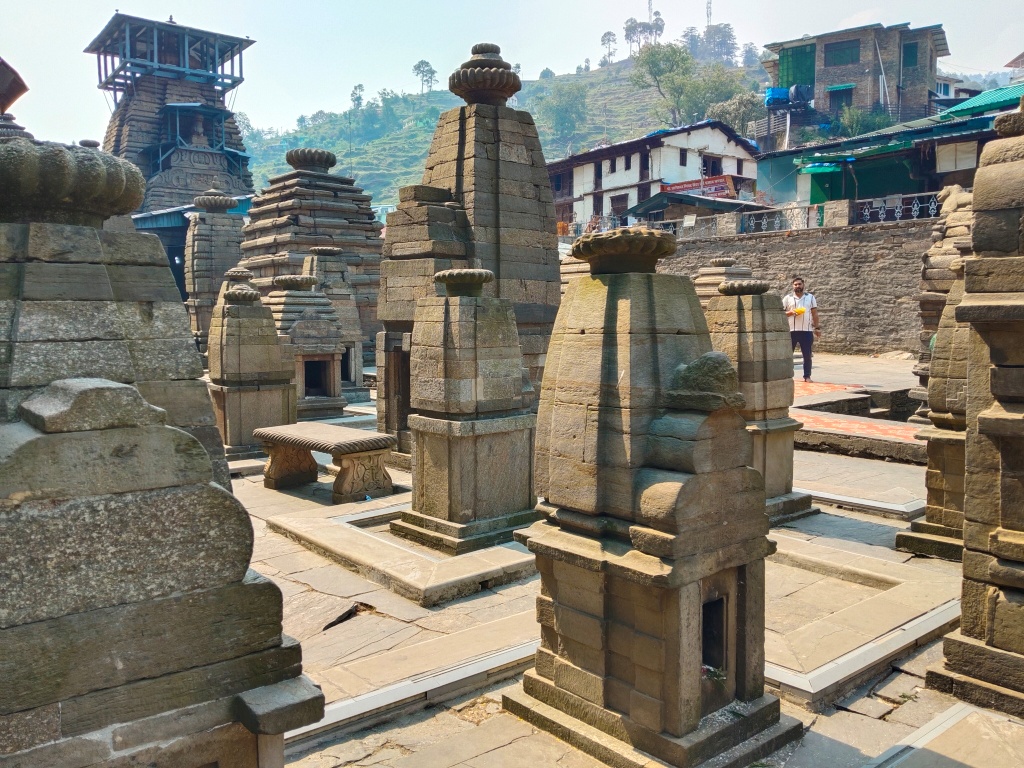
Standing peacefully beside the Gomti River is the magnificent Baijnath Temple, one of the most important Shiva temples in the Kumaon region. The main shrine, dedicated to Lord Shiva, is surrounded by 17 subsidiary temples, creating an impressive medieval temple complex.
The present temple is believed to have been built around 1150 AD by a Katyuri ruler, when this region was known as Kartikeyapura, the capital of the powerful Katyuri dynasty. Today, the temple is protected by the Archaeological Survey of India, recognising its immense historical and architectural importance.
Baijnath Temple Complex
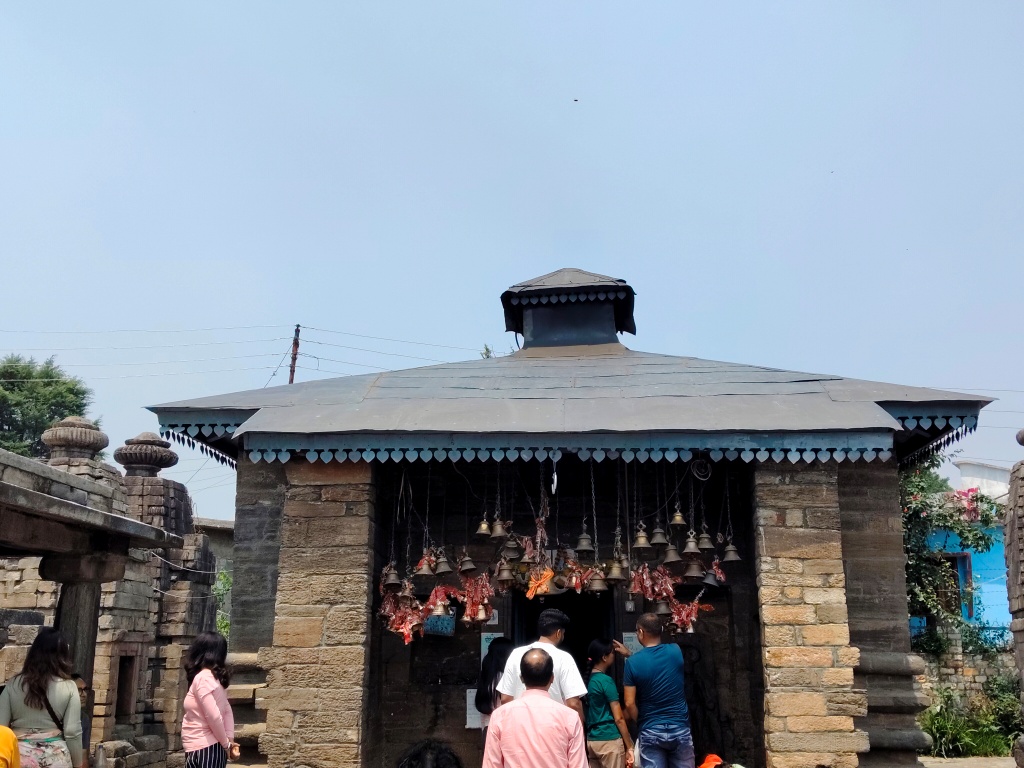
Main (Shiva) shrine
According to Hindu tradition, this sacred location marks the place where Lord Shiva and Goddess Parvati were married. Inside the temple complex are beautifully carved idols of Shiva, Parvati, Ganesha, Surya, Kubera, Brahma, Chandika, and several other deities.
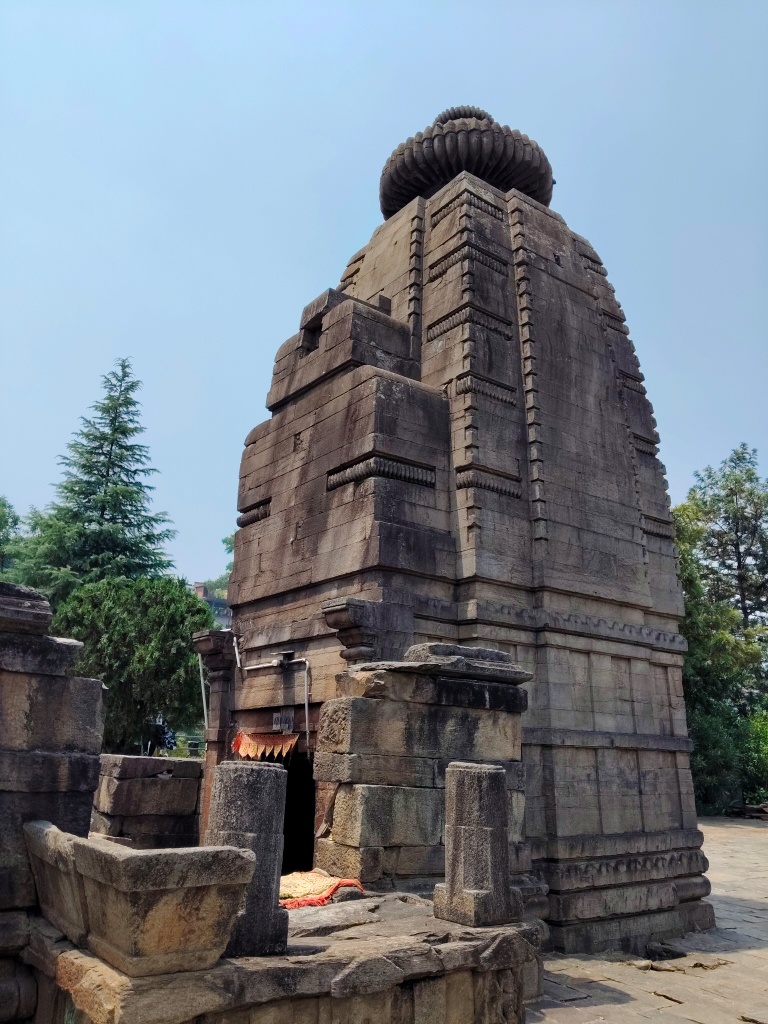
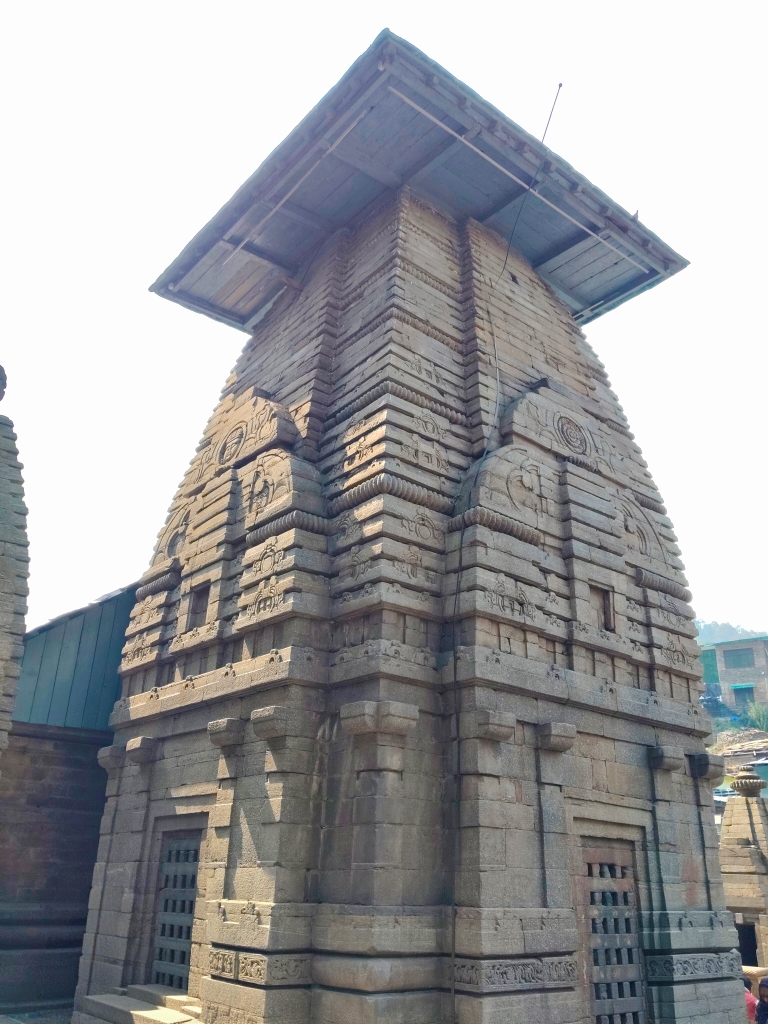
Architecturally, the temple is an outstanding example of the Nagara style of North Indian temple architecture. The soaring shikharas, intricate stone carvings and the temple’s Pancharatha layout showcase the remarkable craftsmanship of medieval artisans.
I spent nearly an hour exploring the peaceful temple complex. Before leaving, I bought some popcorn and fed the fish swimming in the clear waters of the Gomti River.
Baijnath – Other Temples
Following the Gomti Valley to Bageshwar
My next destination was Bageshwar, another historic town that holds immense religious importance in Kumaon. A shared taxi costing ₹70 covered the journey in about 45 minutes, along the Gomti river valley. By 1:00 PM, I reached Bageshwar.
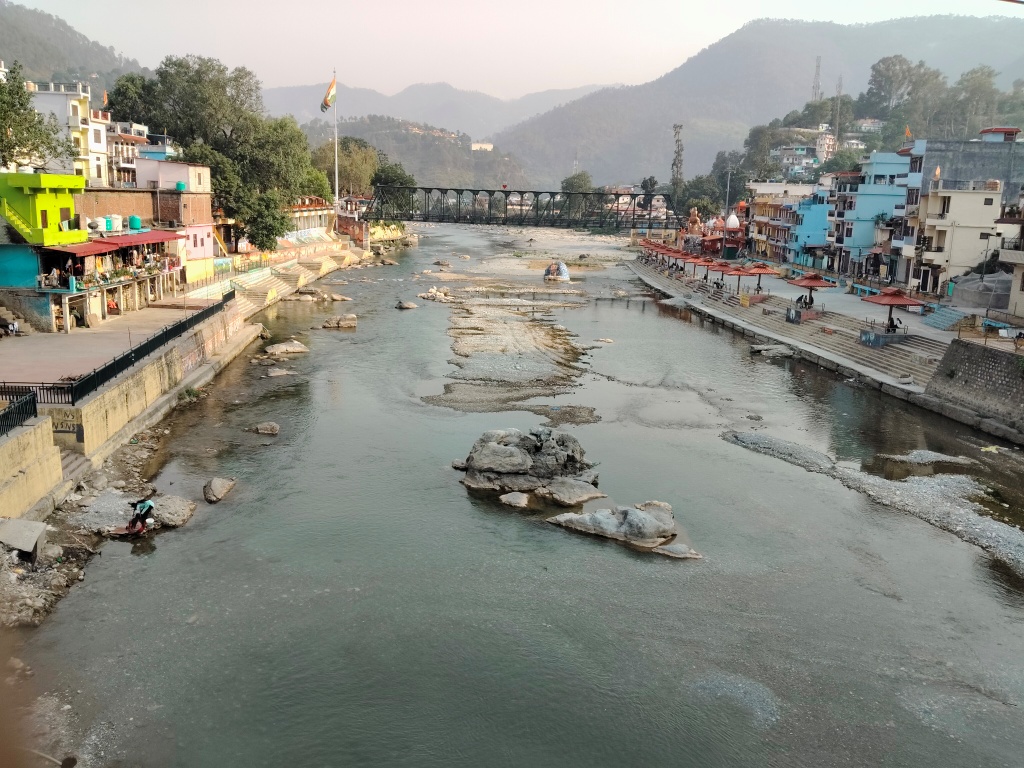
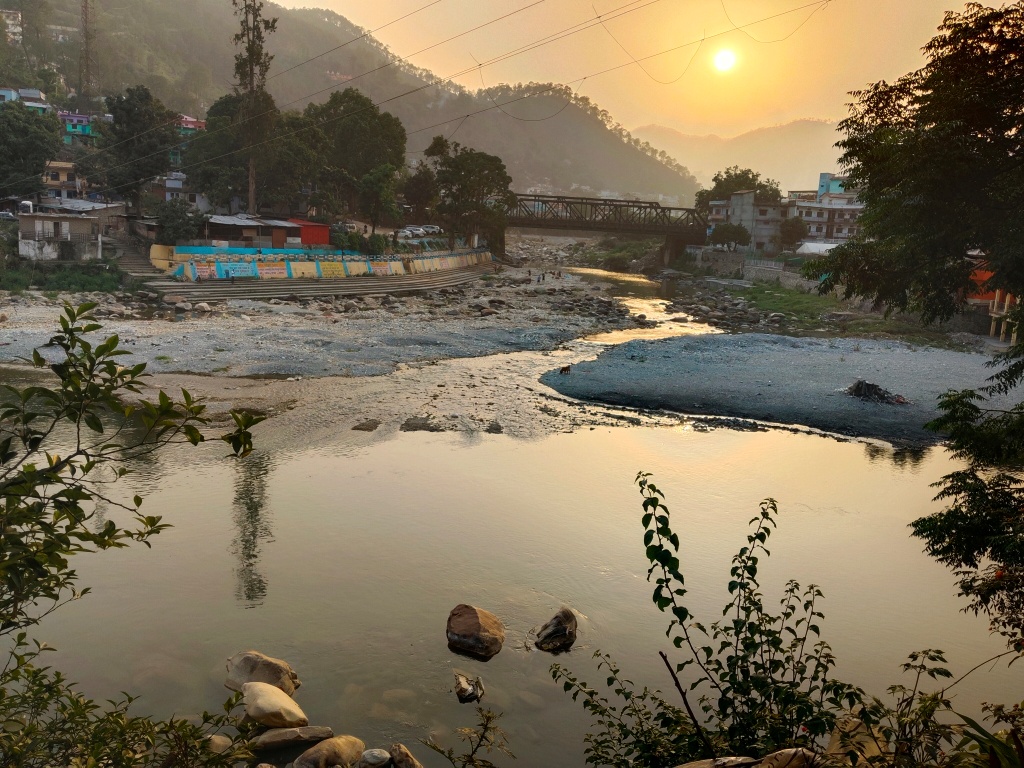
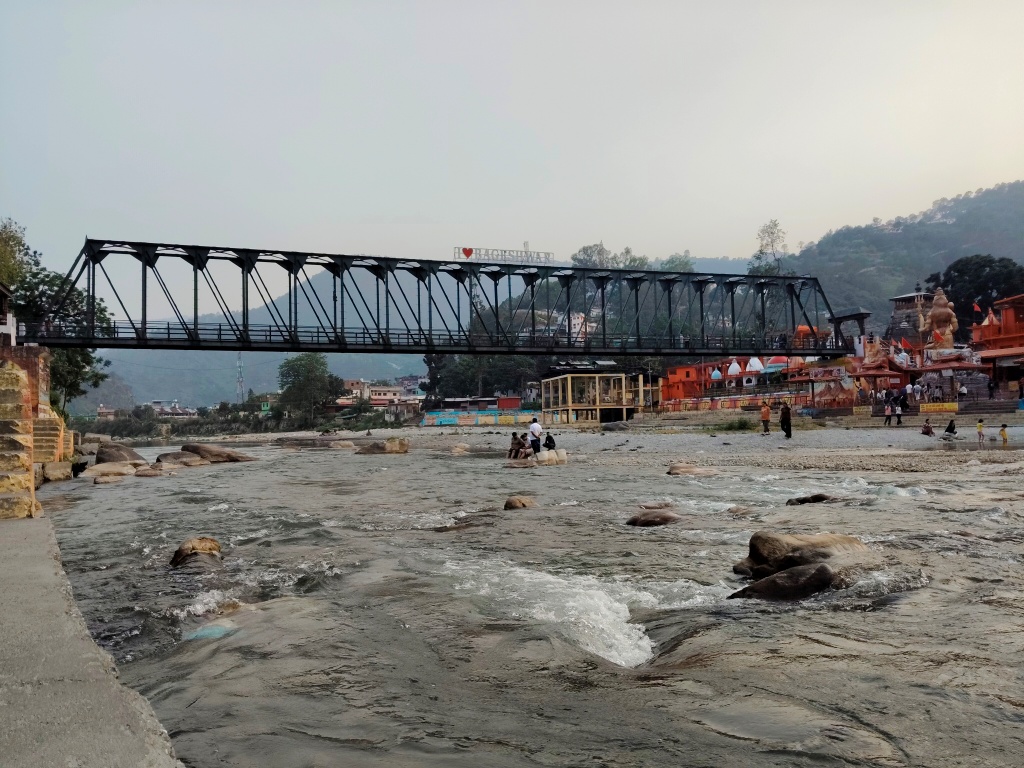
Iron bridge over Sangam
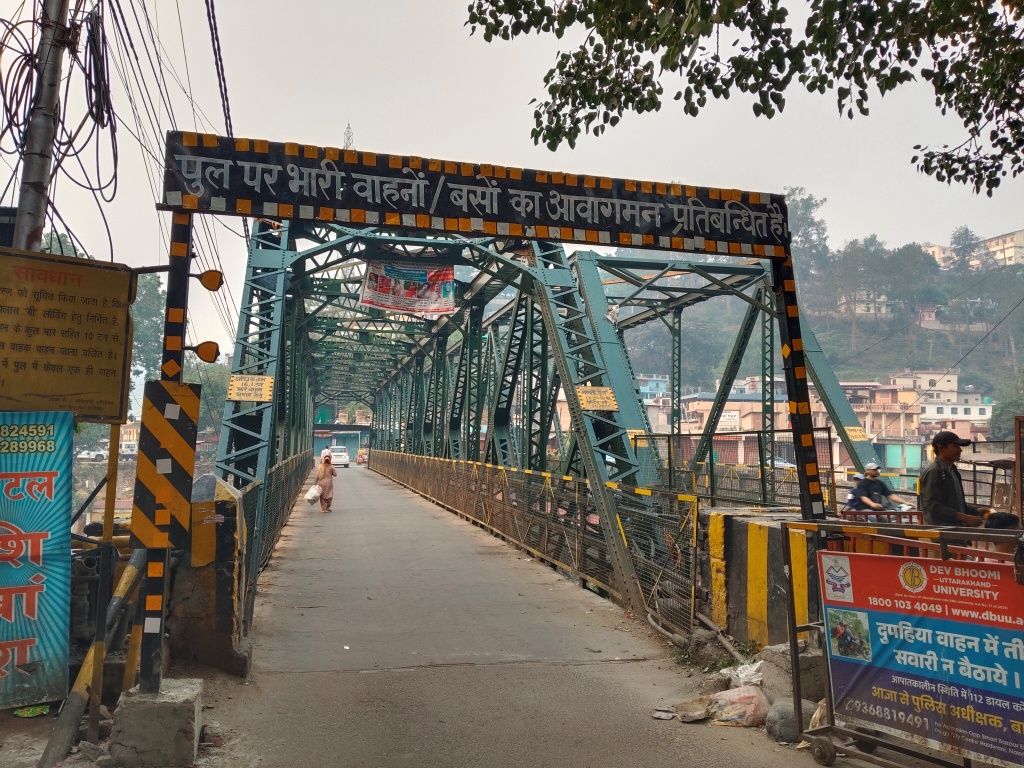
By the time I reached Bageshwar, it was around 1:00 PM. Before exploring the town, I needed a comfortable place to spend the night. While planning this trip, I had come across several positive reviews of the KMVN (Kumaon Mandal Vikas Nigam) Tourist Rest House, so I decided to stay there. The property was about a kilometre’s walk from the taxi stand. I soon crossed the iron bridge and saw the first glimpse of the samgam flowing below it.
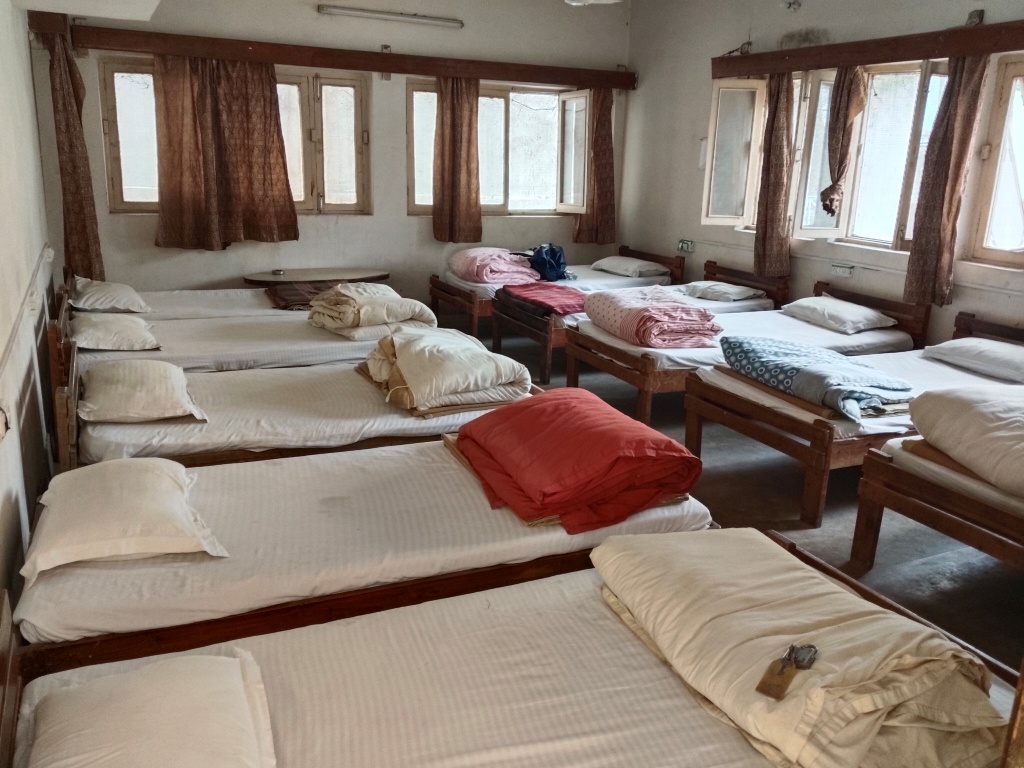
Google maps took me to the rest house and at the reception I was told that they offered two options: Dormitory bed: ₹300 per night & Standard room: ₹1,200 per night. Since this entire journey was built around a ₹4,000 budget, choosing the dormitory was an easy decision.
To my surprise, I was the only guest occupying one bed in the 10-bed dormitory. For the price of a hostel bed, I practically had the entire dorm to myself. After freshening up, I headed out for lunch.
KMVN rest house
Dormitory
The KMVN rest house has several restaurants nearby. I had lunch of a simple Veg. thali at Daawat Restaurant, which costed me ₹160, making it another budget-friendly meal on the trip.
By now it was around 2:30 PM. Unlike Kausani, Bageshwar sits at a much lower altitude, and the afternoon felt noticeably hot. Rather than exploring in the afternoon heat, I returned to the guest house for some rest. My plan was to visit the town’s most important attraction – Bagnath Temple – during the evening when the weather would be more pleasant.
Exploring Bageshwar
Around 5:00 PM, the weather became comfortable again, and I stepped out towards Bagnath Temple. The short walk through the streets of Bageshwar became an experience in itself.
Unlike popular hill stations that revolve around tourism, Bageshwar feels like a living Himalayan town. The bustling markets, narrow lanes, local businesses and everyday life reminded me of the spiritual towns of Haridwar and Rishikesh, but on a smaller scale.
Sangam
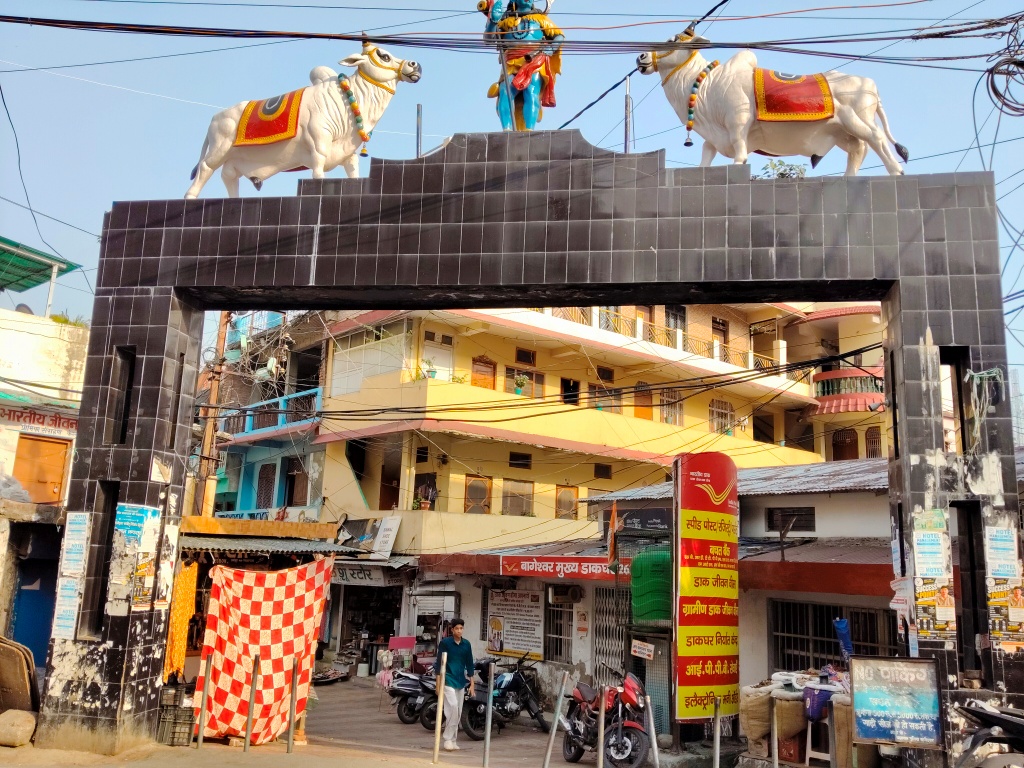
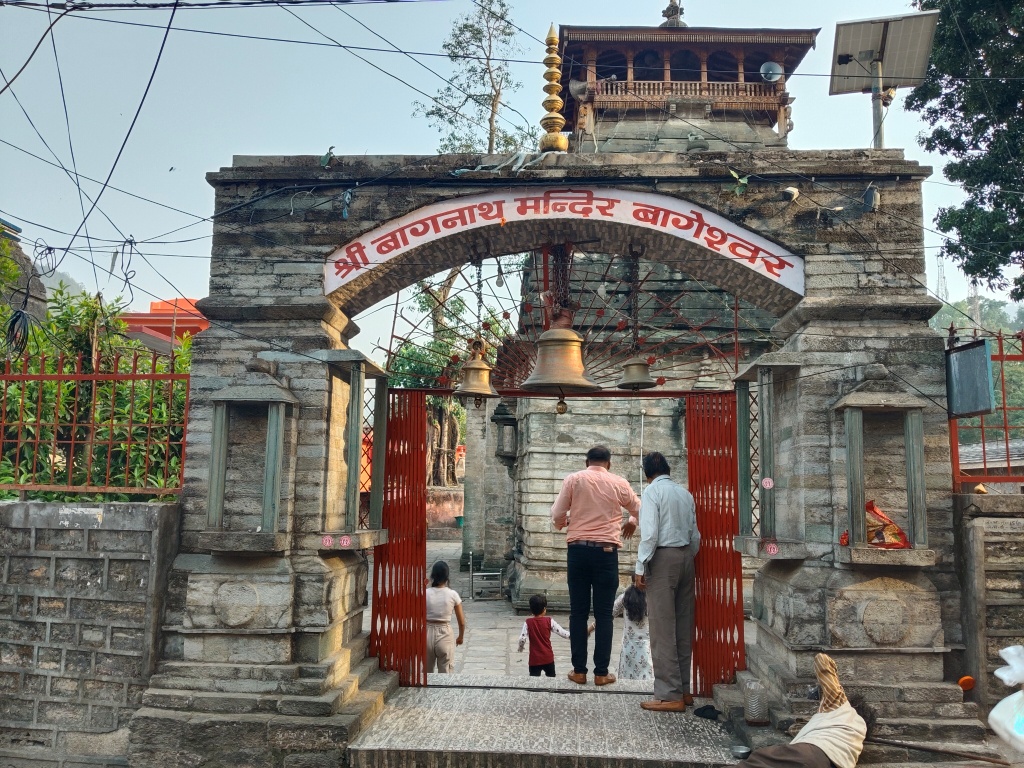
Entry Gate -Bagnath Temple
Several iron bridges connect different parts of the town across the Saryu and Gomti rivers. The relaxed pace of life, combined with the constant sound of flowing water, gave Bageshwar a unique charm that I instantly liked. Soon, the narrow alleys led me to the entrance of Bagnath Temple.
Bagnath Temple – The Spiritual Heart of Bageshwar
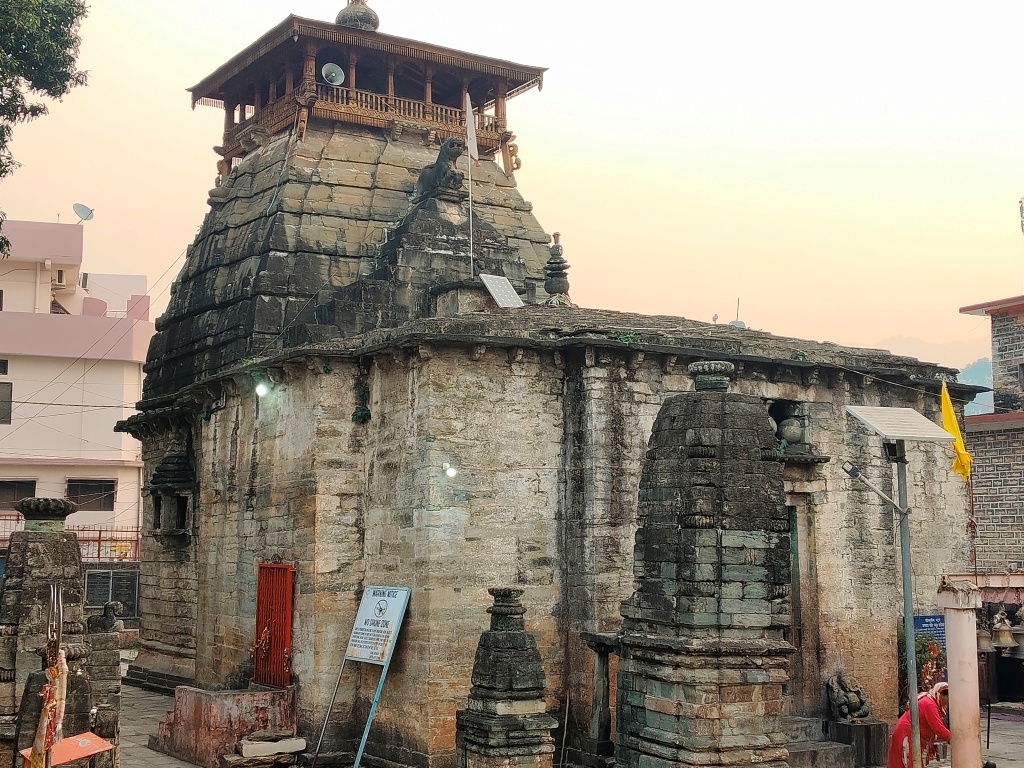
Bageshwar derives its name from Bagnath Temple. The temple stands at the sacred confluence of the Saryu and Gomti rivers.
Many people associate the Saryu River with Ayodhya, but its origins lie much higher in the mountains of Uttarakhand. The river flowing beside Bagnath Temple is the upper course of the same river system. After travelling through the Himalayan region, it eventually becomes a major tributary of the Ghaghara River, whose lower reaches are locally known as the Saryu in Ayodhya.
According to historical records, a temple has existed at this site since around the 7th century AD. The present structure, however, was constructed in 1450 AD by Chand ruler Laxmi Chand in the classic Nagara architectural style.
Bagnath Temple
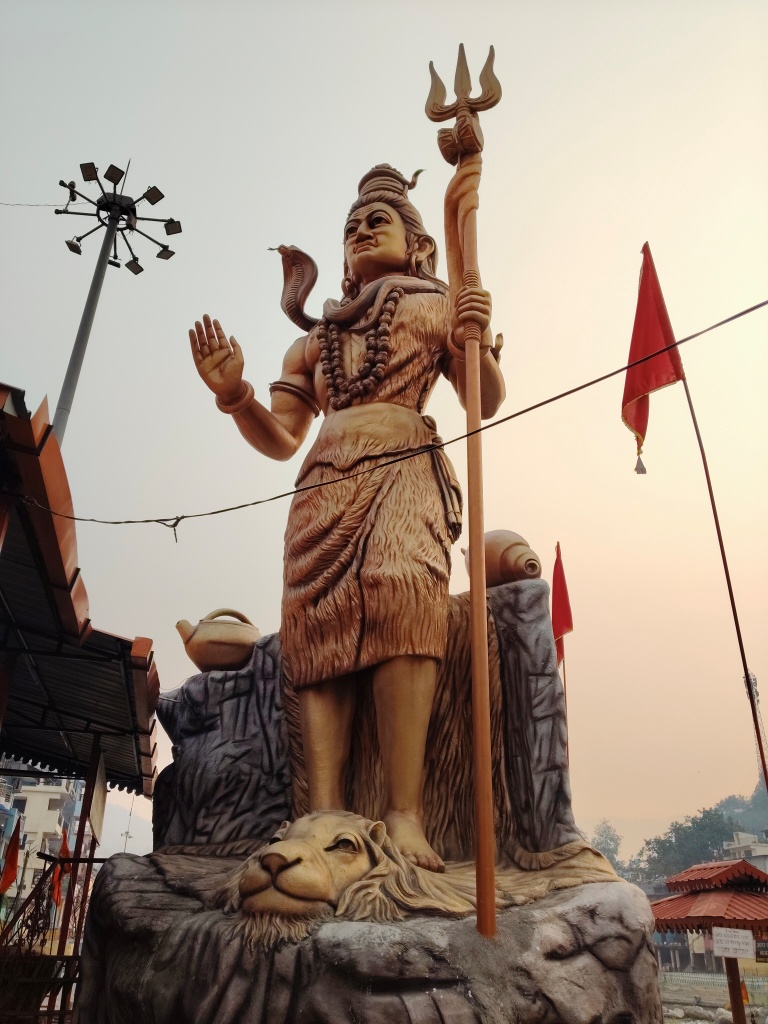
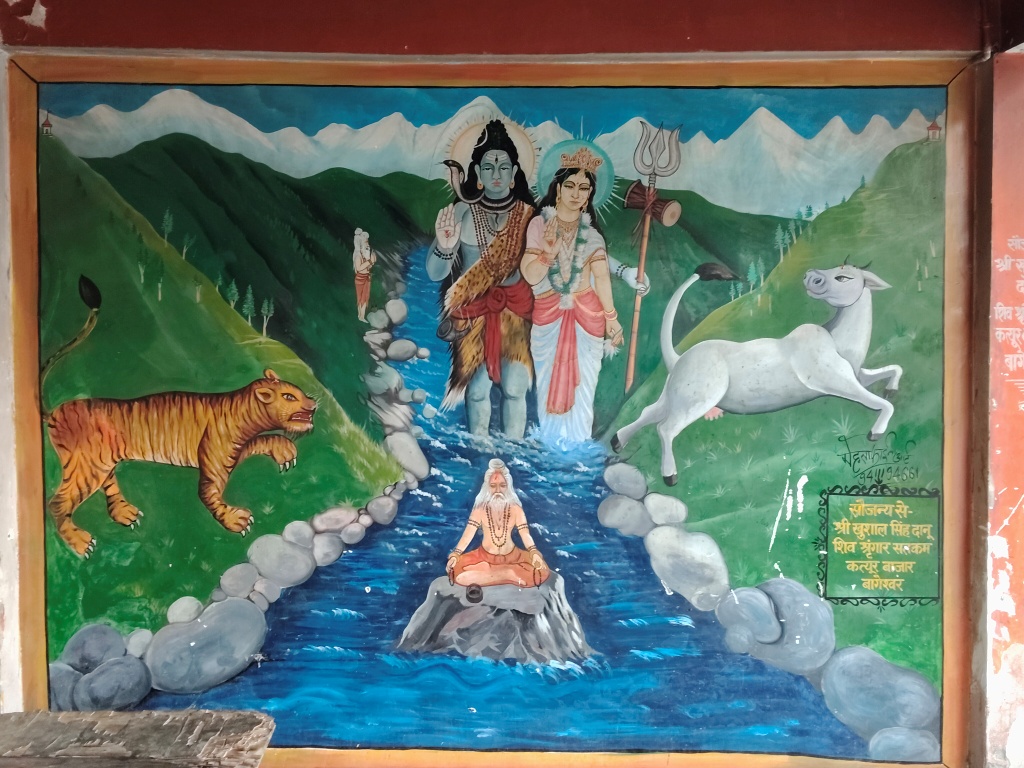
The story behind the temple’s name is one of its most fascinating aspects. According to legend, Brahmarishi Vashishtha was guiding the waters of the Saryu River from Mansarovar towards Ayodhya. When he reached this location, he found Rishi Markandeya deeply absorbed in meditation. Fearing that the flowing river would disturb the sage’s penance, Vashishtha paused, causing the river to swell. Seeking a solution to possible devastation due to flood, he prayed to Lord Shiva. Shiva arrived with Goddess Parvati, assuming the form of a tiger, while Parvati took the form of a cow. When the tiger chased the cow, the resulting commotion awakened Rishi Markandeya, allowing Vashishtha to continue leading the river downstream. From that day onward, Lord Shiva came to be worshipped here as Baghnath – the Lord in the form of a tiger.
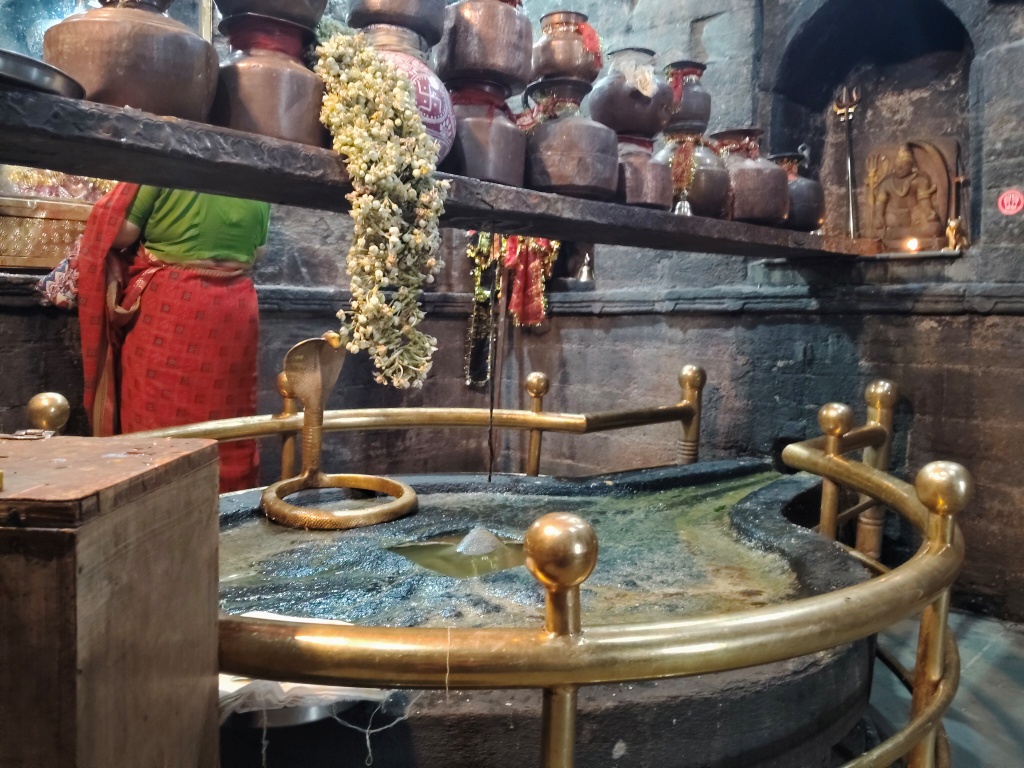
Shiva Linga
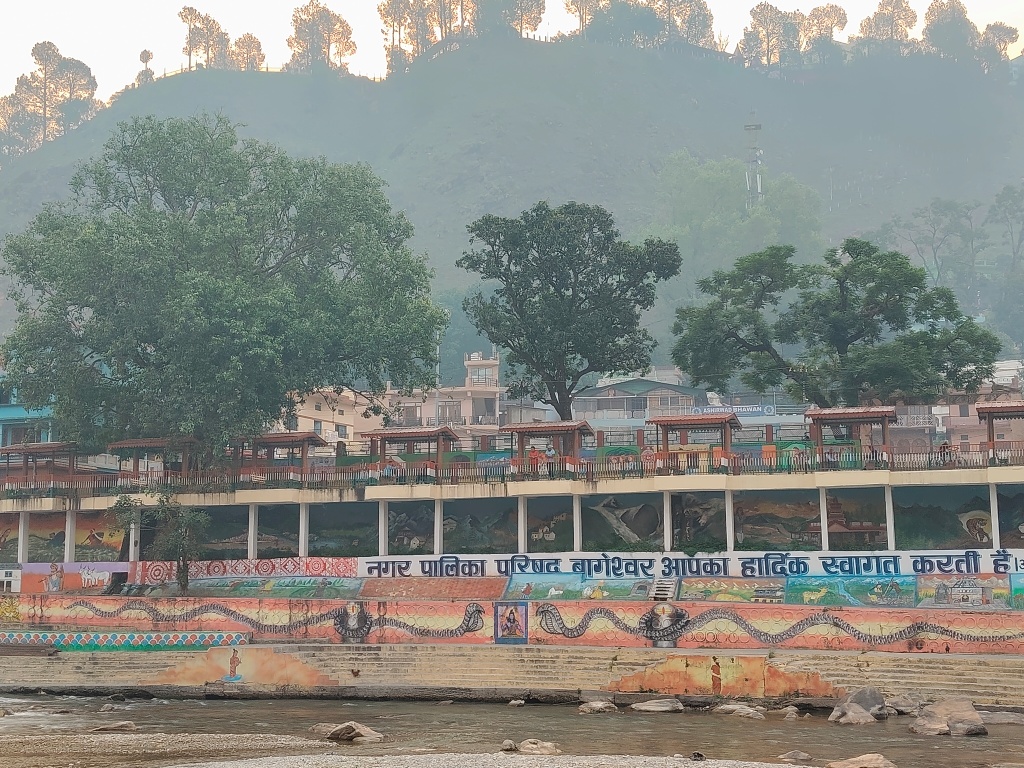
Graffiti depicting the legend behind the temple
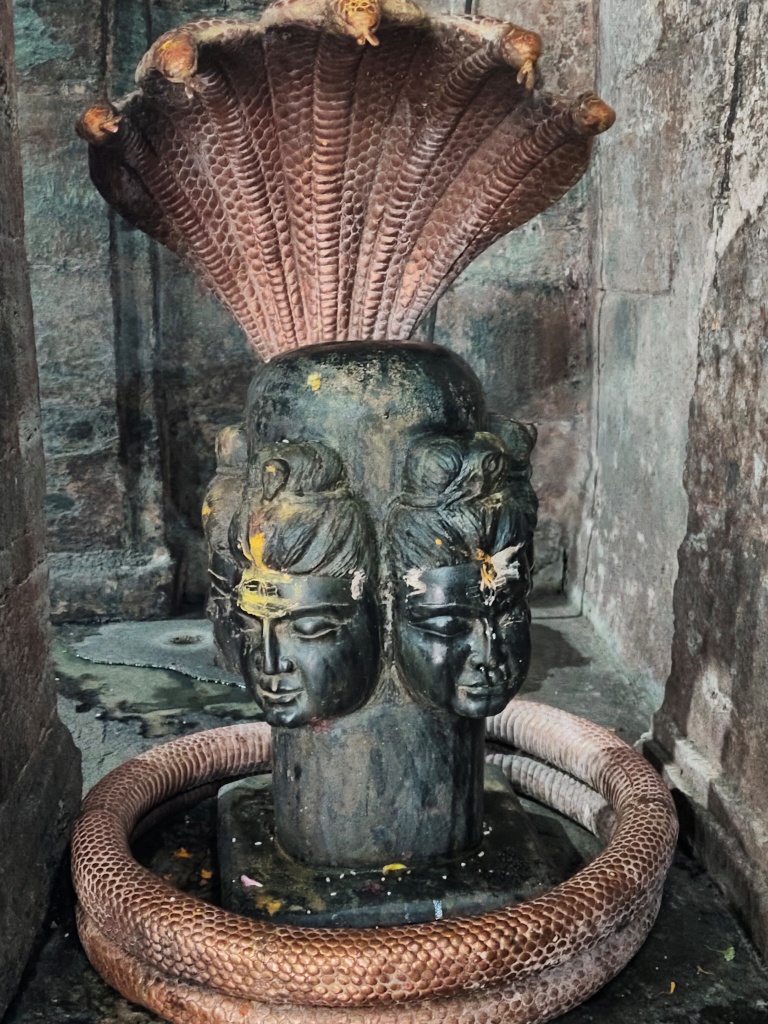
The temple houses a remarkable collection of ancient idols. The main attraction is the Chaturmukhi Shivalinga, representing Lord Shiva with four faces. Apart from this, visitors can see idols of Ganesha, Vishnu, Kartikeya and several other deities.
Chaturmukhi Shivalinga
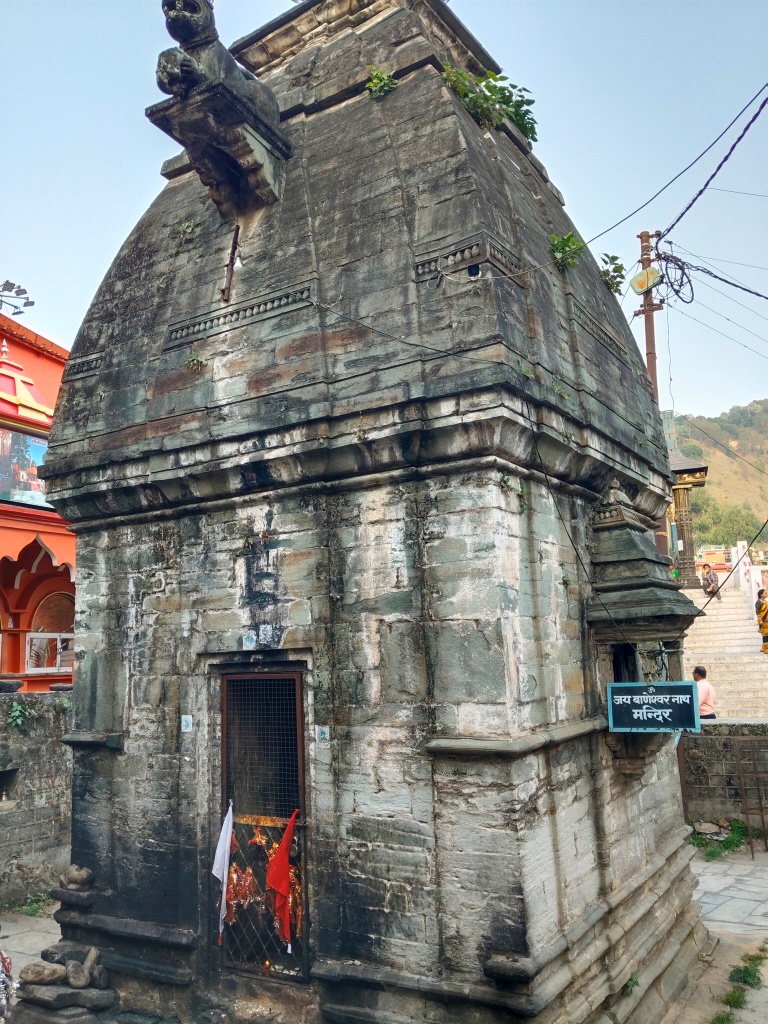
Baneshwar Temple
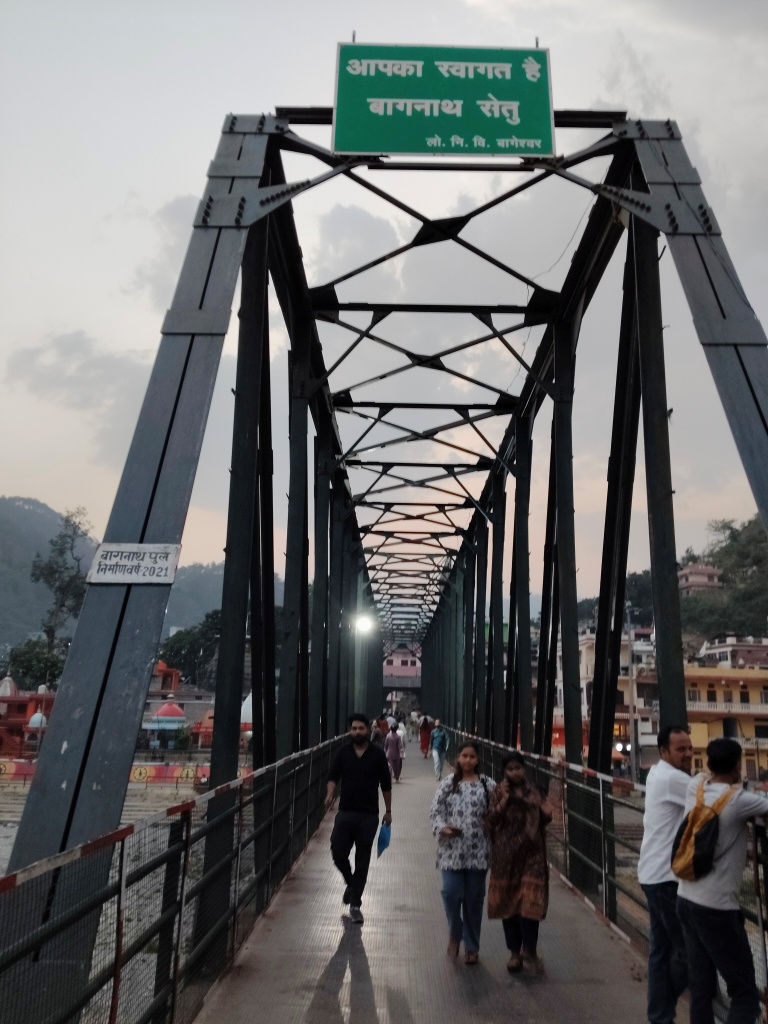
Bagnath Setu
After exploring the temple complex, I paid a quick visit at Baneshwar Mahadev Temple which is located next to Bagnath Temple. It is comparatively smaller and is dedicated to Lord Shiva, who is worshipped here as Baneshwar Mahadev. It is believed that a visit to Bageshwar is spiritually complete only after visiting both Bagnath and Baneshwar Mahadev Temple.
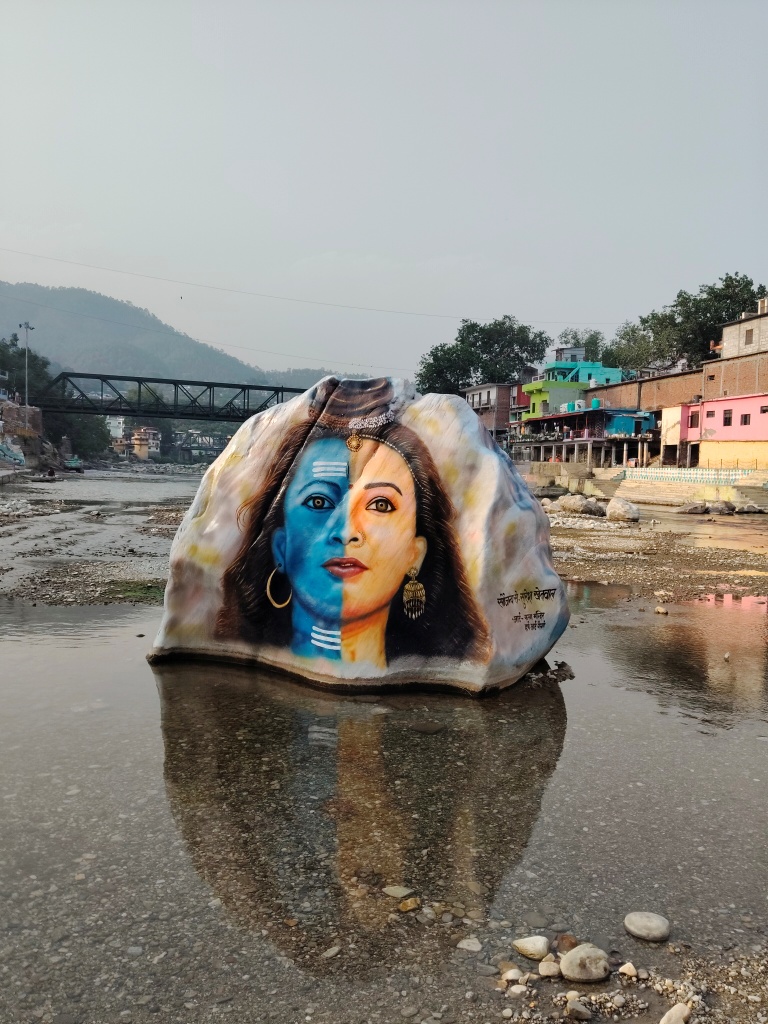
Sangam-Gomti & Saryu meeting point
Banks of Sangam
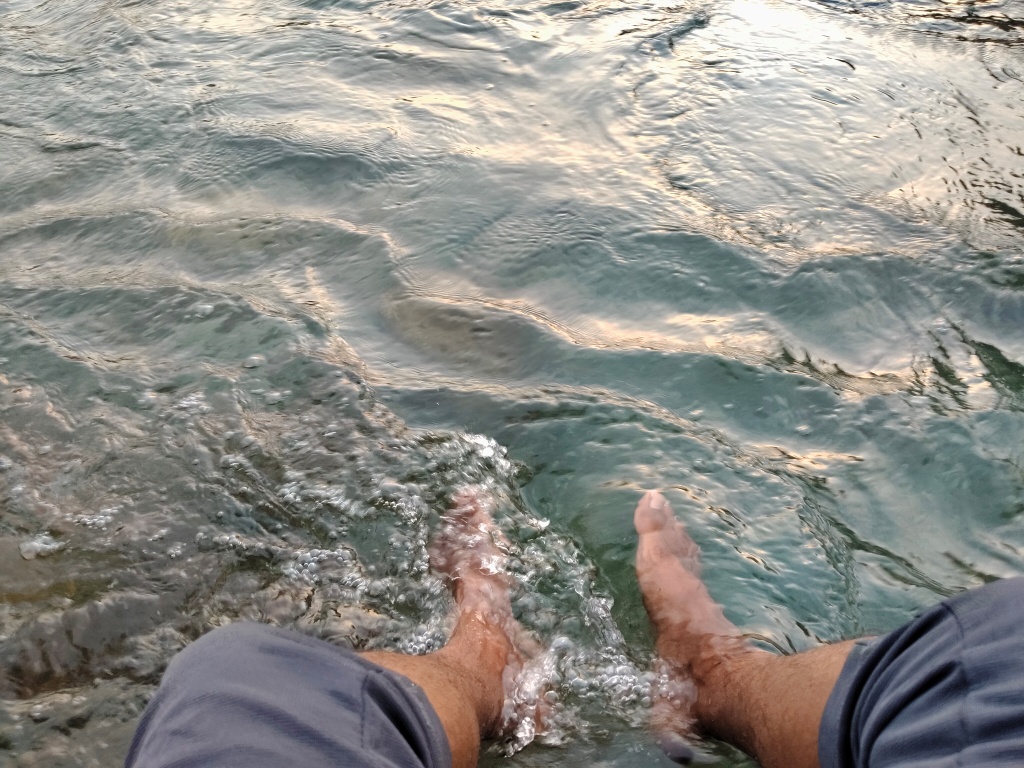
After paying my respects to Baneshwar Mahadev Temple , I crossed Bagnath Setu and made my way to the banks of the sacred confluence of the Saryu and Gomti rivers. With a cup of tea in hand, I found a quiet spot by the water and sat with my feet immersed in the cool river water. For a while, time seemed to slow down. The soothing sound of the gently flowing river, the rhythmic ringing of temple bells, and the cool evening breeze came together to create one of the most serene and memorable moments of my entire journey.
Witnessing the Evening Aarti
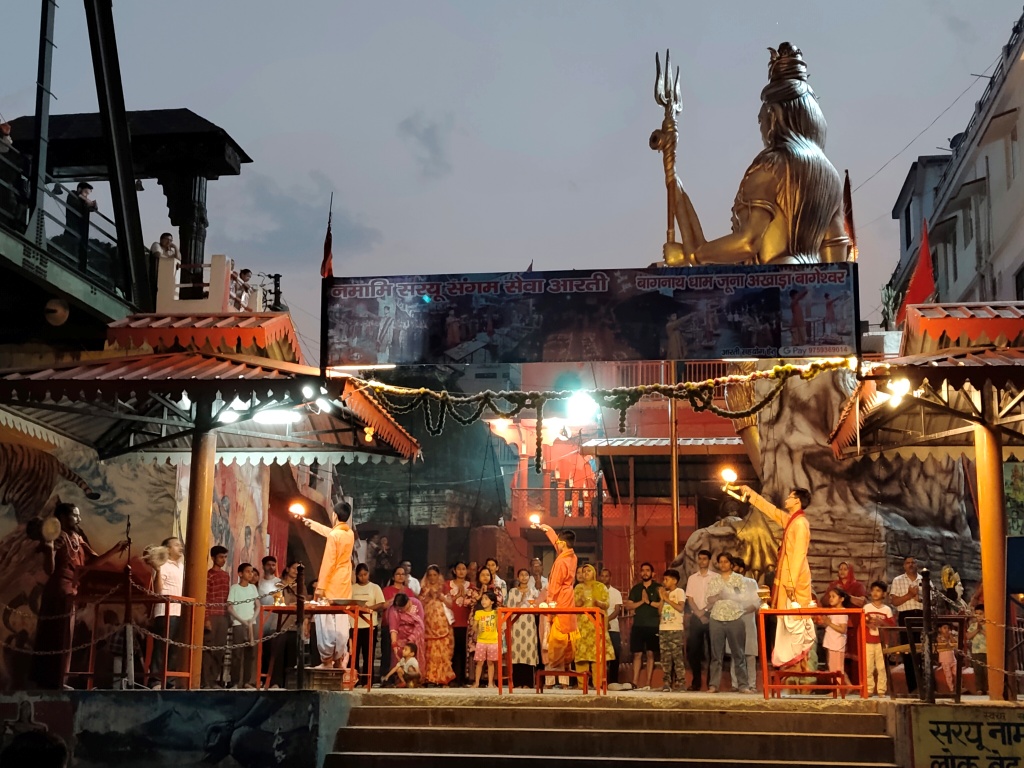
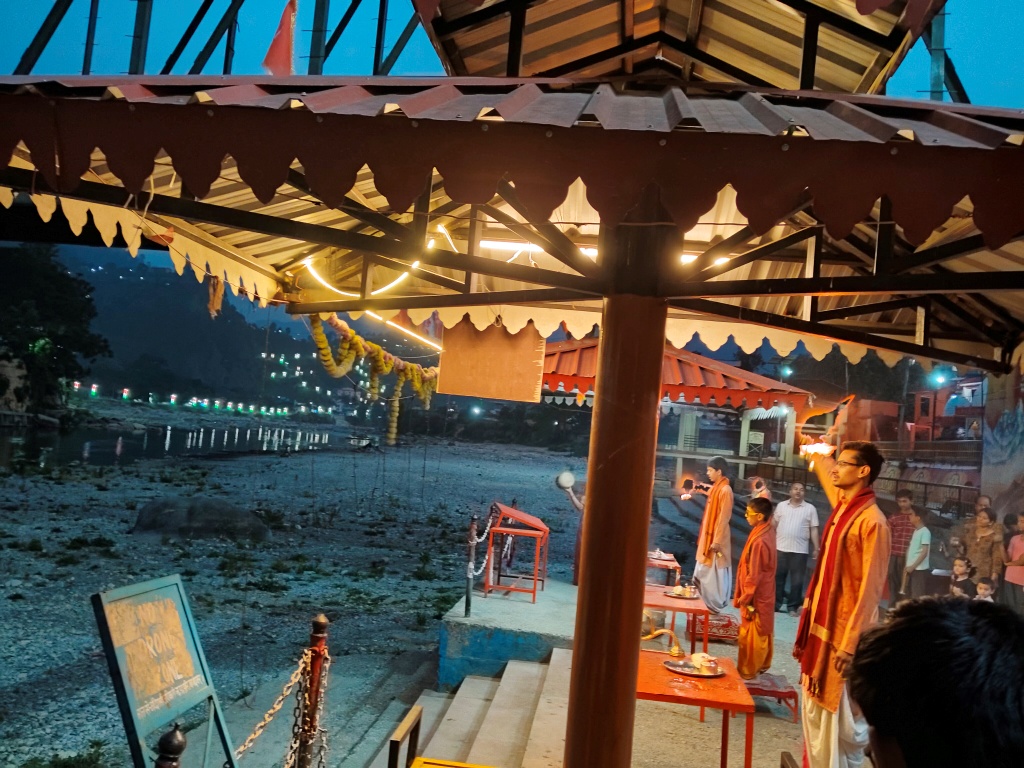
Around 7:30 PM, it was time for the evening Aarti. The temple bells echoed across the river while priests performed the rituals beside the sacred confluence. The sound of flowing water, devotional chants and the surrounding Himalayan landscape came together to create an unforgettable spiritual atmosphere.
Evening Aarti
Ending the Day with Street Food
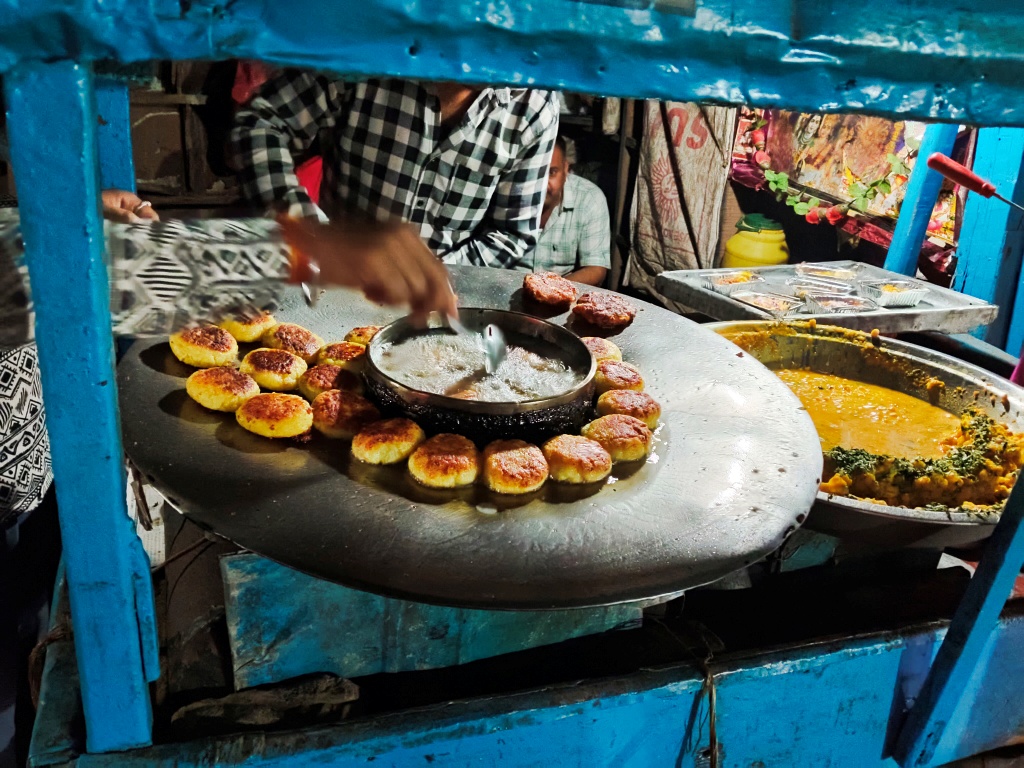
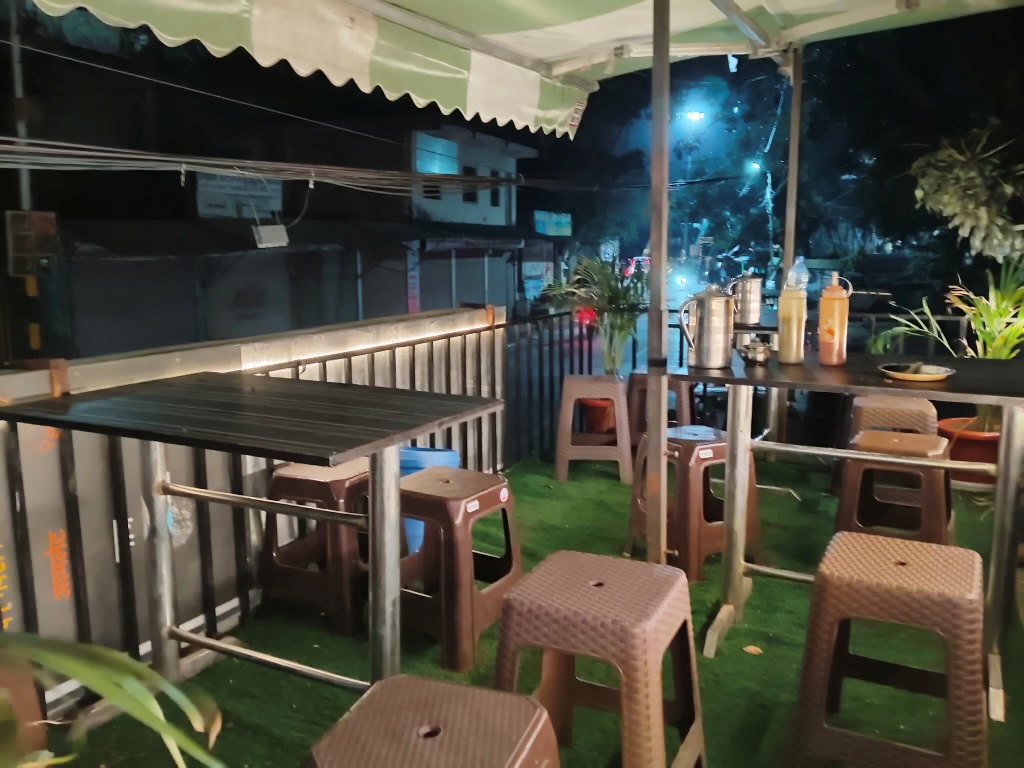
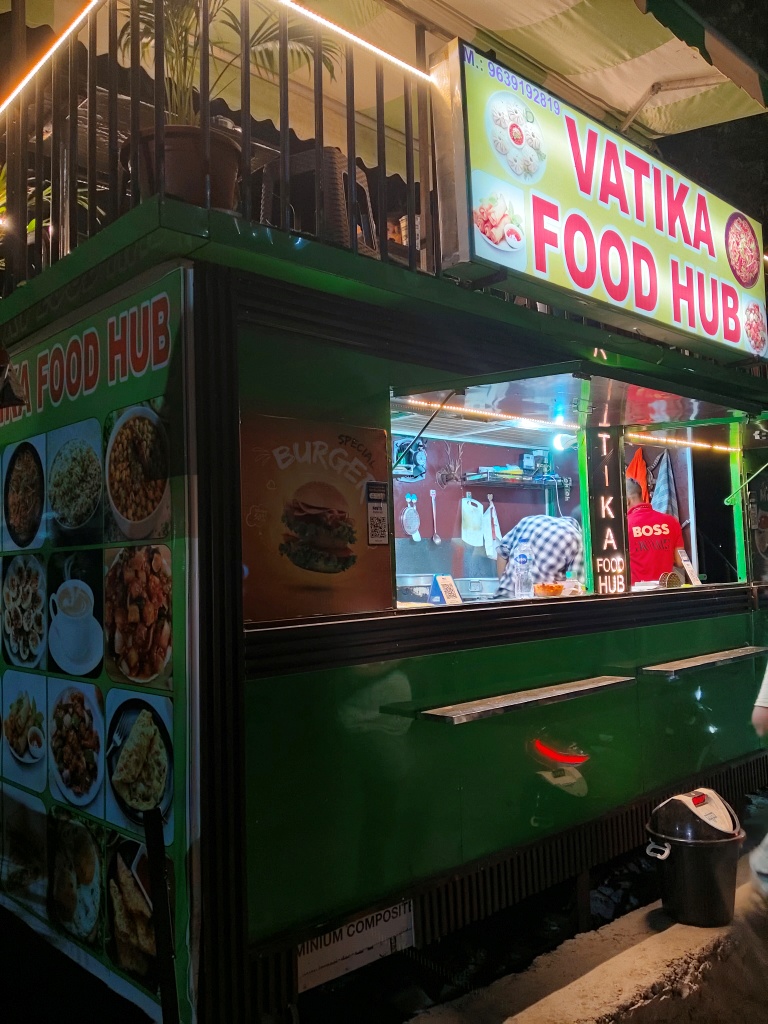
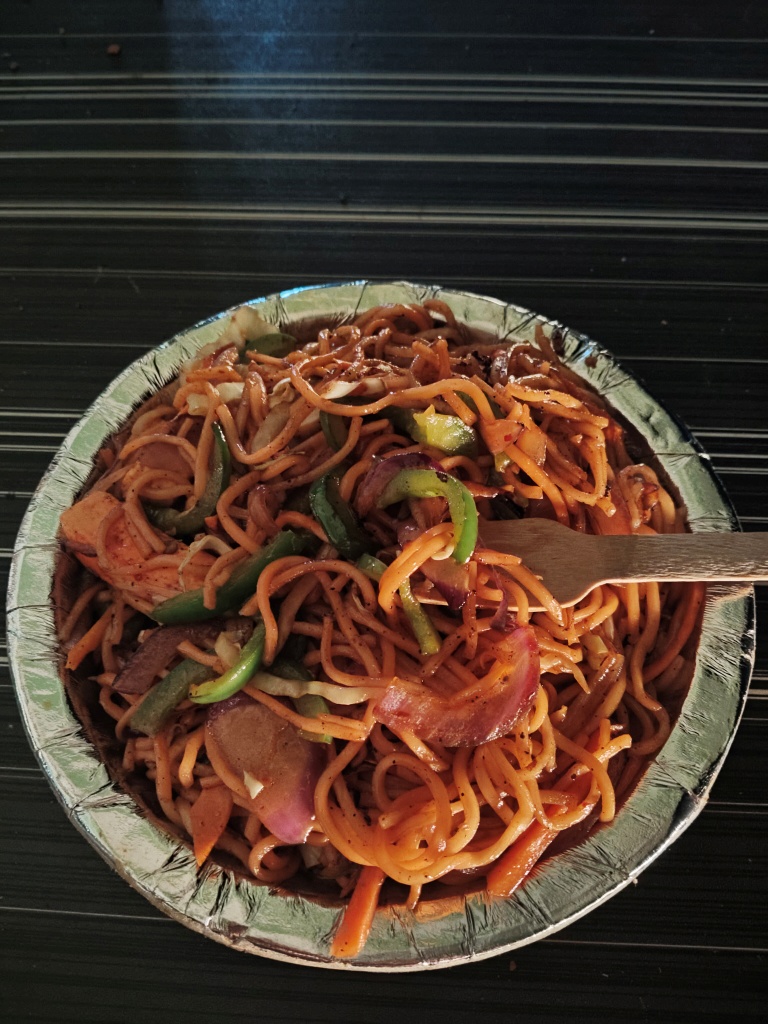
After the evening aarti, I wandered through market in search of dinner but soon found myself drawn to the tempting aromas of street food. A small stall selling ‘aloo tikki’ with chole had gathered quite a crowd – a sure sign that it was worth trying. I ordered a plate for just ₹25, and it certainly lived up to my expectation. As I continued exploring the market, another eatery caught my eye – Vatika Food Hub. Unlike a conventional restaurant, it operated from a uniquely designed double-decker food truck. I ordered a plate of veg. chowmein for ₹60 and enjoyed it from the upper deck of the food truck.
As I ended the day over a plate of chowmein, I couldn’t help but notice that hill towns seem to have a knack for serving this simple dish exceptionally well. Every bite transported me back to my childhood summer vacations in another beautiful hill city of Uttarakhand -Dehradun. Visiting my maternal grandparents and enjoying chowmein (and ‘katlambe’) was something I eagerly looked forward to every year. It was a nostalgic way to end a memorable day in Bageshwar.
Day 3: Bageshwar to Jageshwar & Return Home to Rudrapur
The third and final day of my budget Uttarakhand solo trip had two objectives. The first was to visit Jageshwar Dham, one of the most sacred Shiva temple complexes in India. The second was to make my way back home to Rudrapur, bringing this three-day journey across Kumaon to an end.
Although the destinations looked close on the map, reaching Jageshwar from Bageshwar isn’t straightforward. There is no direct public transport between the two towns. The only practical option is to first travel to Almora and then change to another shared taxi heading towards Jageshwar (see map)
An Early Morning Start
I woke up around 6:30 AM, freshened up, packed my backpack and checked out of the KMVN Tourist Rest House. Before leaving Bageshwar, I wanted to have breakfast. Most restaurants were still busy with their morning preparations, but luckily I found a small eatery that had already started serving food.
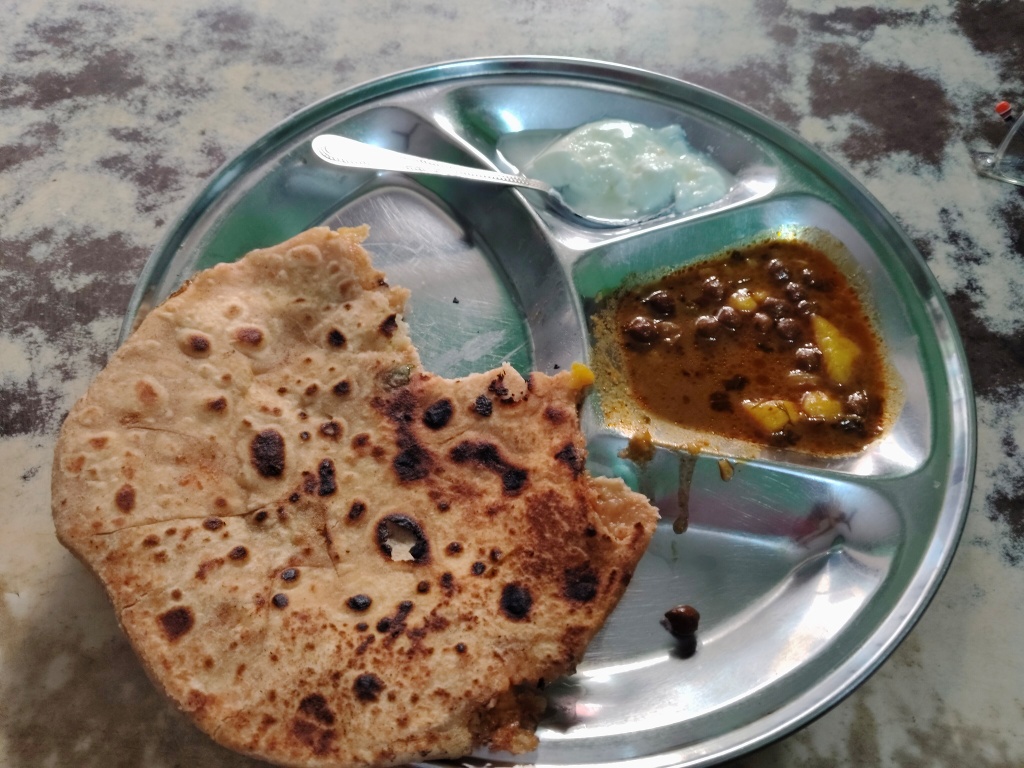
The breakfast menu was simple. I ordered ‘aloo parathas’, which, much like the previous day, were served with chana gravy – a combination that seems quite popular across the Kumaon region. A hot cup of tea completed the meal. The breakfast cost me ₹110.
Shared Taxi to Almora
At around 8:00 AM, I boarded a shared cab bound for Almora. Unlike my onward journey through Kausani and Baijnath, this cab followed the Takula – Binsar route.
Although this route is shorter, the journey wasn’t necessarily faster. Road-widening work was underway across several stretches. Mountains were being cut to expand the highway, leaving broken roads, loose gravel and frequent slow-moving traffic. Despite the rough conditions, the mountain scenery remained beautiful throughout the drive. The shared taxi fare from Bageshwar to Almora was ₹250.
Bageshwar to Almora
After nearly three and a half hours, I reached NTD Chauraha in Almora at around 11:30 AM. NTD Chauraha serves as one of Almora’s major road intersection, making it the best place to catch shared taxis and buses going towards Jageshwar.
Another Shared Taxi to Jageshwar
After waiting for about 15-20 minutes, another shared taxi picked me up for Jageshwar. The drive took around one and a half hours, costing ₹150. Since it was Sunday, the roads were noticeably busier than anywhere else I had visited during the trip.
Jageshwar is located just off the Almora-Pithoragarh Highway. The shared cab dropped me at a designated point on the highway, about 3 km before the main temple complex. Since it was a weekend, the influx of pilgrims and tourists was high, and private vehicles and shared cabs were not permitted to proceed any further. From here, dedicated shuttle cabs ferried visitors to the temple complex for just ₹20 per person.
On the way, we passed Dandeshwar Temple, another ancient Shiva shrine located about 1.5 km before Jageshwar Dham. Unfortunately, the shuttle cab didn’t stop there, so I had to give it a miss.
Jageshwar Dham – Walking Through More Than a Hundred Ancient Temples
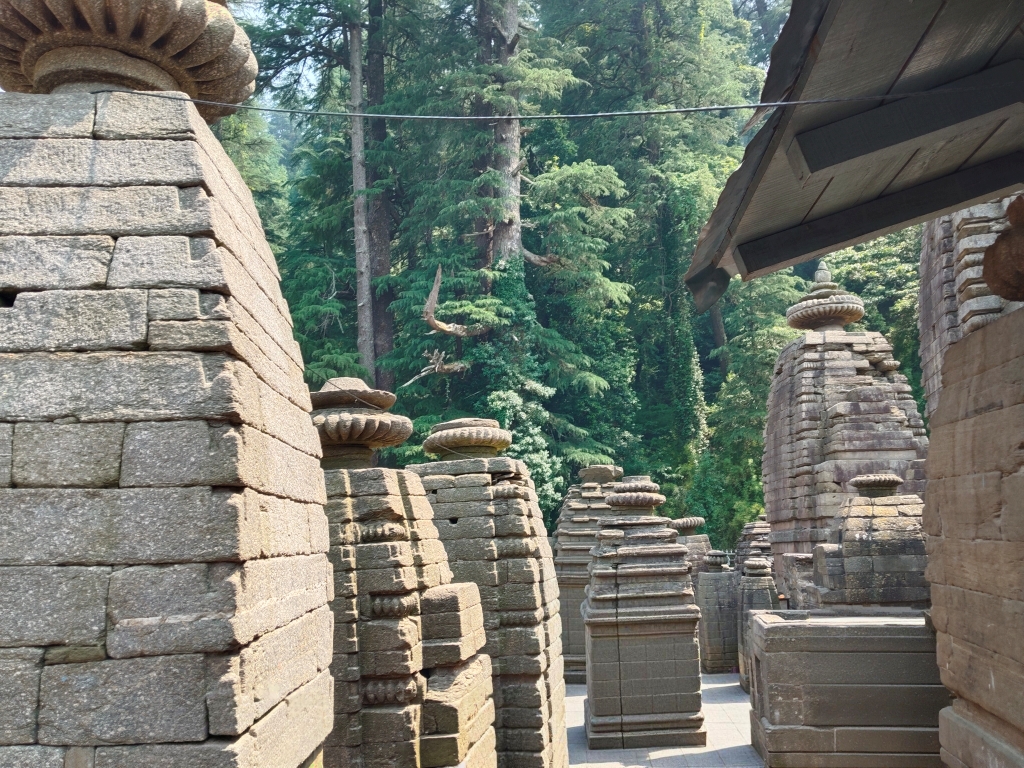
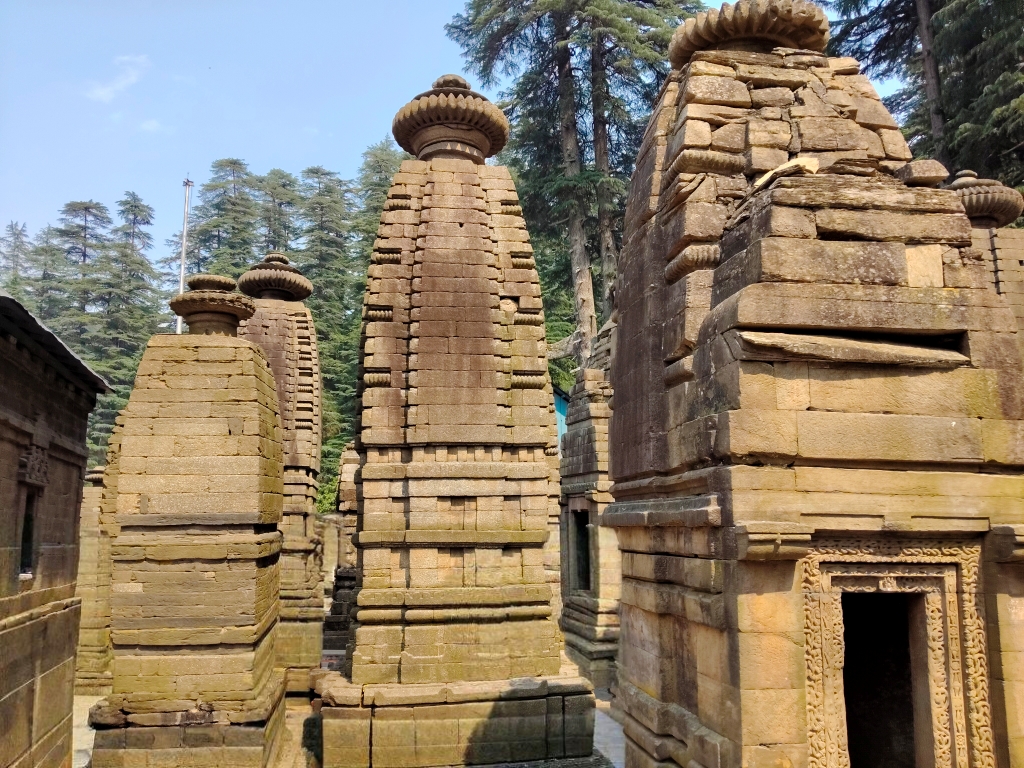
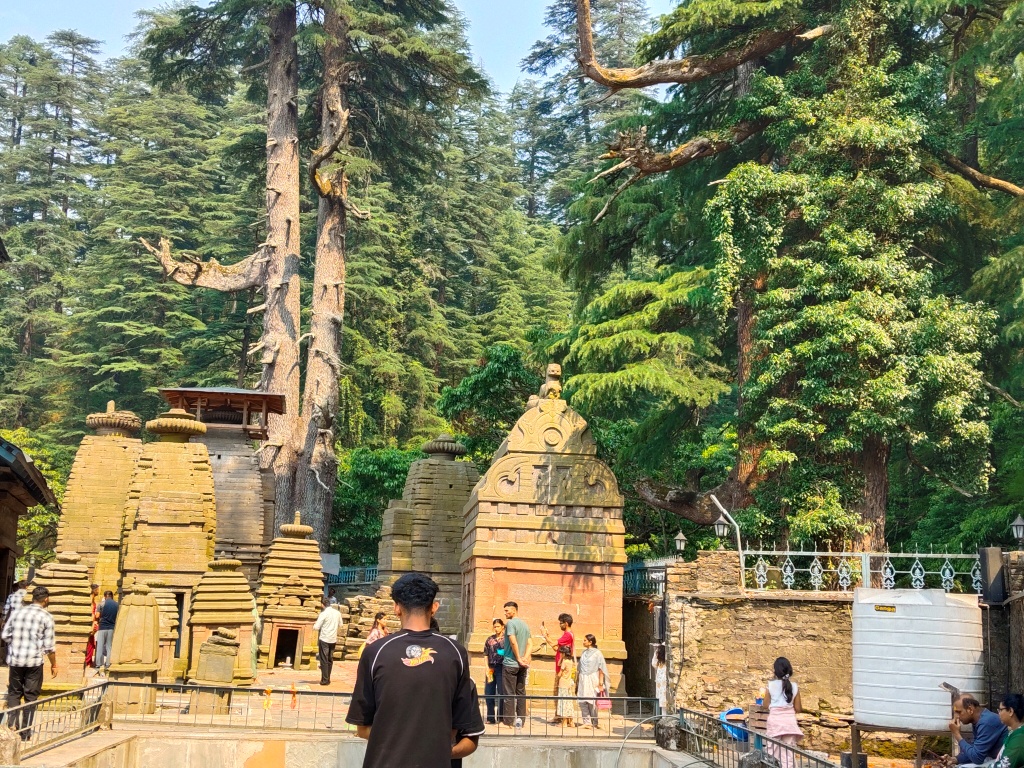
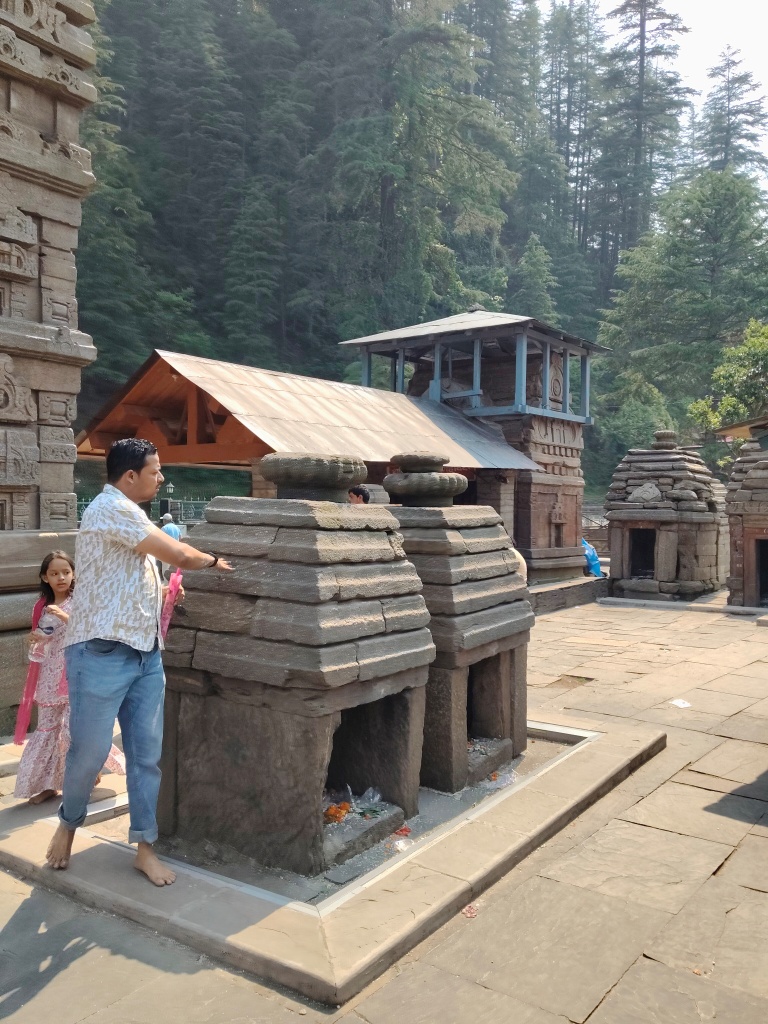
Around 15 minutes later, I finally arrived at the magnificent group of ancient temples at Jageshwar Dham.I Nestled amid towering deodar forests, flowing mountain streams and peaceful Himalayan surroundings, Jageshwar Dham immediately feels different from most temple towns.
Located at an altitude of about 1,870 metres, it is often referred to as the “Valley of Gods.” Unlike many temples that consist of a single shrine, Jageshwar is an entire temple city.
Jageshwar Dham
According to archaeological studies, the temple complex is believed to be nearly 2,500 years old. Local traditions state that many of these temples were originally built by the Chand rulers before being rediscovered by Adi Shankaracharya during his mission to revive Hinduism across the Indian subcontinent.
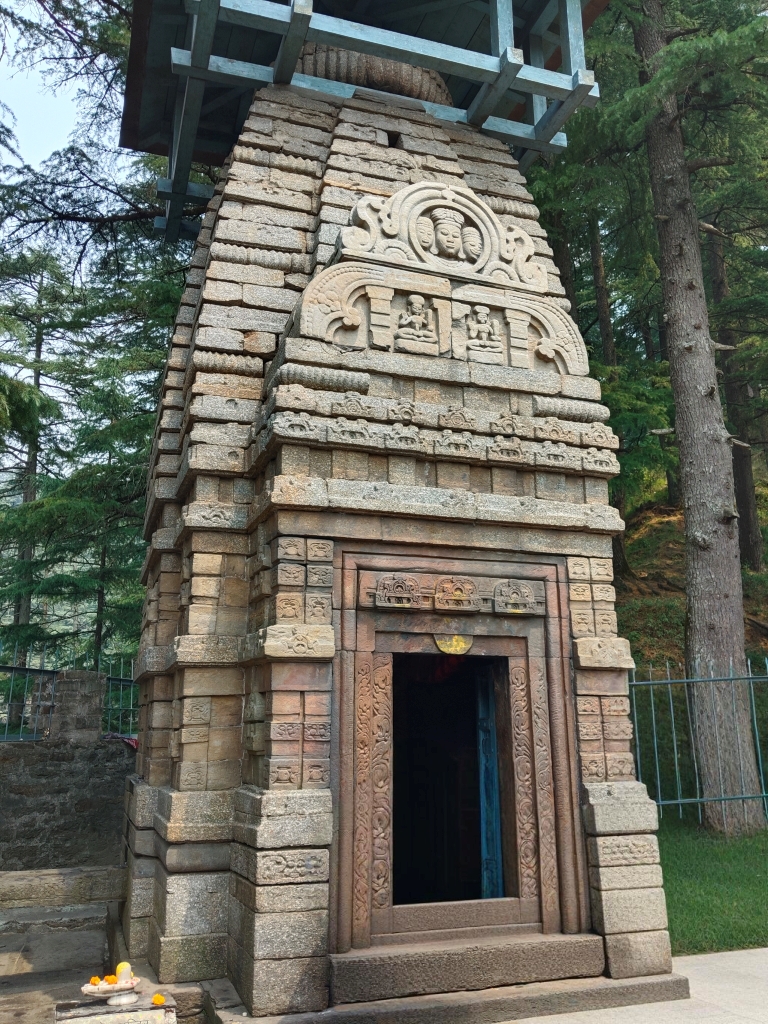
As per one of the signboards within the temple complex, the temples need to be visited in the below sequence – Mahadev Temple >> Hanuman Temple >> Mata Mandir>> Mrityunjaya Temple >> Kedar Temple >> Batuk Bhairav >> Kuber Temple
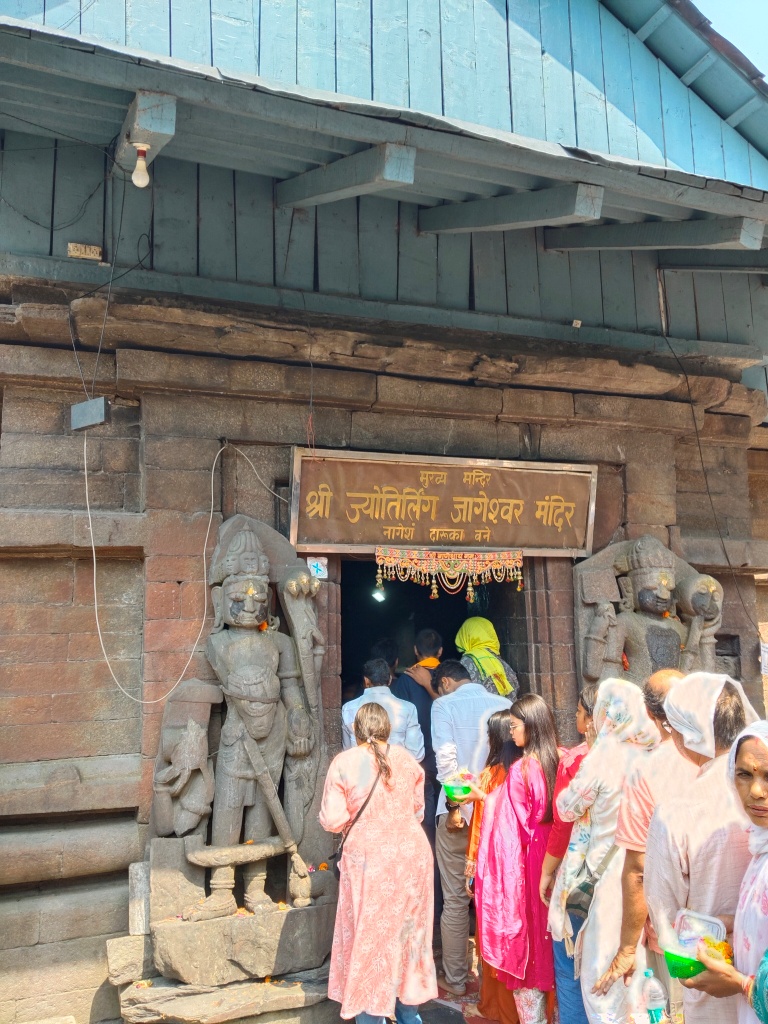
Mahadev (Main) Temple
Mahadev (Main) Temple
Mata Mandir
The principal shrine is Jageshwar Mahadev Temple, where the Shivalinga inside the sanctum is divided into two portions – the larger symbolising Lord Shiva and the smaller representing Goddess Parvati. Many visitors compare its spiritual atmosphere with that of Kedarnath. Another important shrine is the Mrityunjaya Temple, believed to be the oldest temple in the complex. Its large Shiva Lingam is worshipped through the chanting of the Mahamrityunjaya Mantra, with devotees praying for health, protection and long life.
Mrityunjaya Temple
Kedar Temple
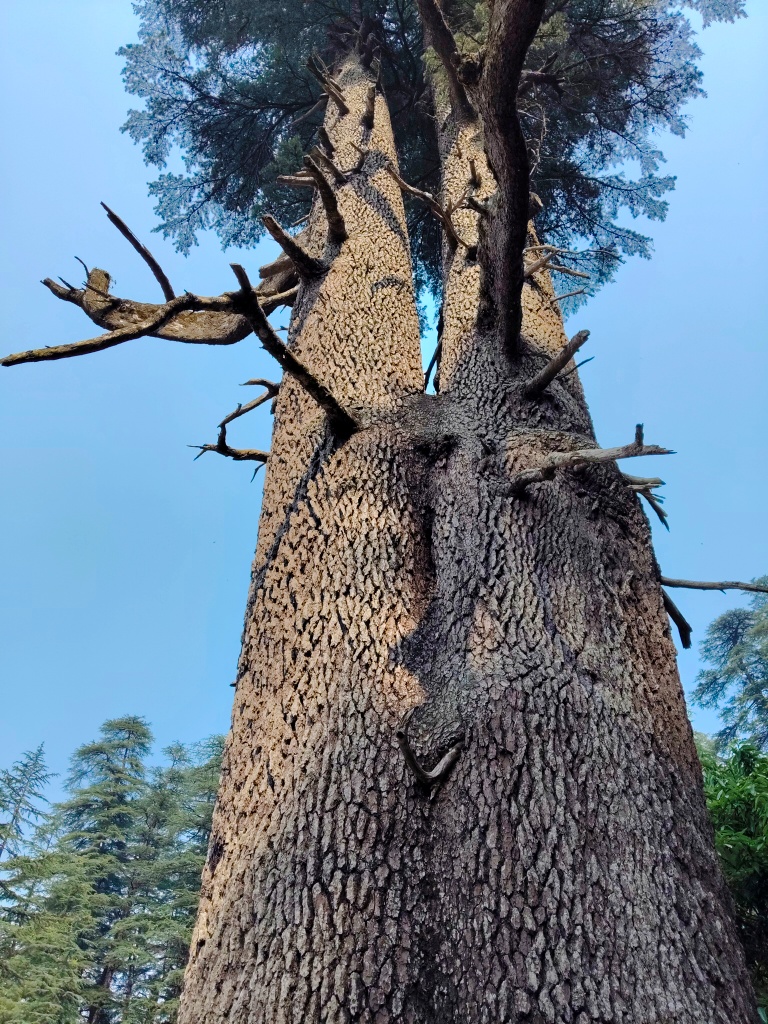
Joint trees
Another interesting attraction in Jageshwar Dham is the “joint trees”. It refers to two massive, naturally intertwined Deodar trees near the Kedarnath temple. Known locally as a symbol of unity, faith, and an unbreakable bond, these majestic trees are believed by devotees to represent Lord Shiva and Goddess Parvati.
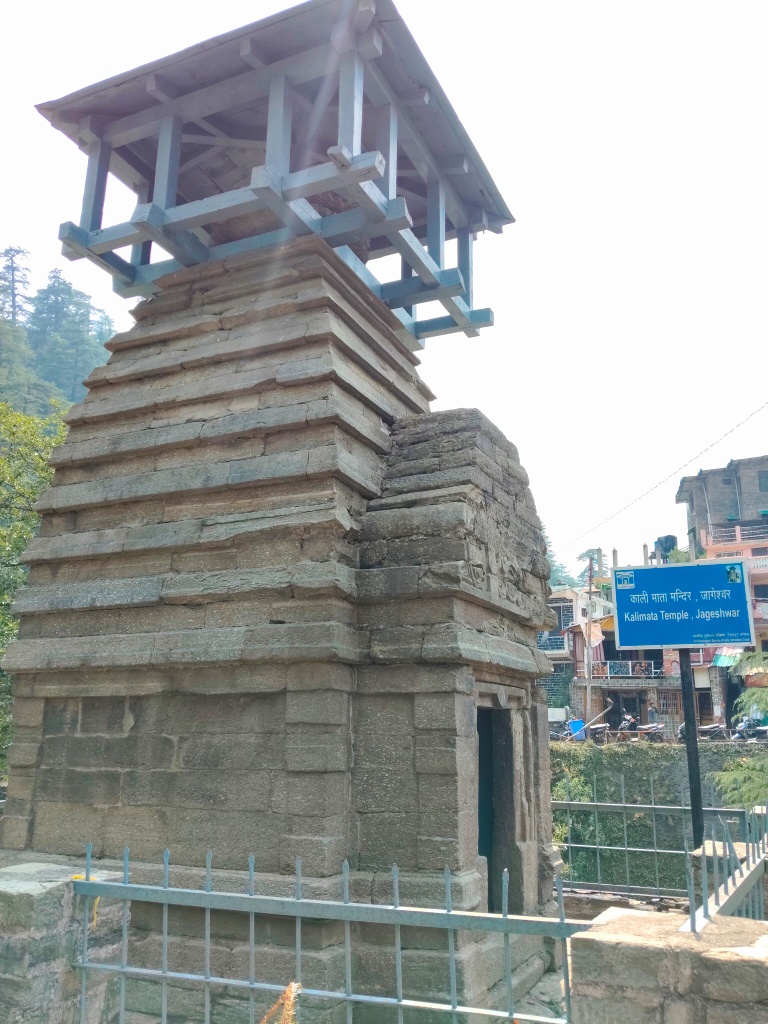
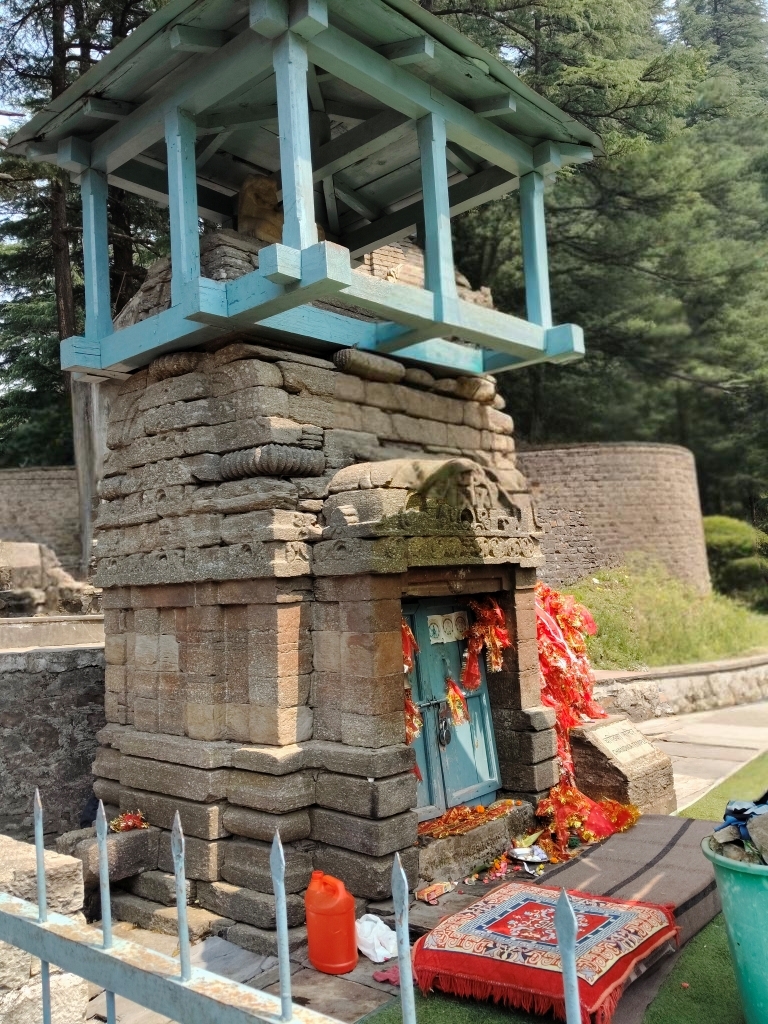
Another unique attraction of Jageshwar is – Kuber temple, which is situated on a slightly elevated hill just a short walk past the main temple complex. Lord Kuber is the Hindu god of wealth. It makes a popular stop for those starting new business ventures or seeking financial blessings. On the way to Kuber temple, you get to pass by Kali Mata mandir.
Kali Mata Mandir
Kuber temple
Chandika temple
Near the temple complex, a Bhandara (community lunch) was being organised. The aroma of freshly prepared food was impossible to ignore. Like many other pilgrims, I joined the queue and enjoyed a hearty meal of pooris and aloo sabji. It was a simple yet memorable experience that reflected the warmth and hospitality often found at pilgrimage centres across India.
Before leaving Jageshwar, I spent some time walking through the small market surrounding the temple. I picked up a few fridge magnets as souvenirs – small reminders of an unforgettable three-day journey through Kumaon.
Did you notice?
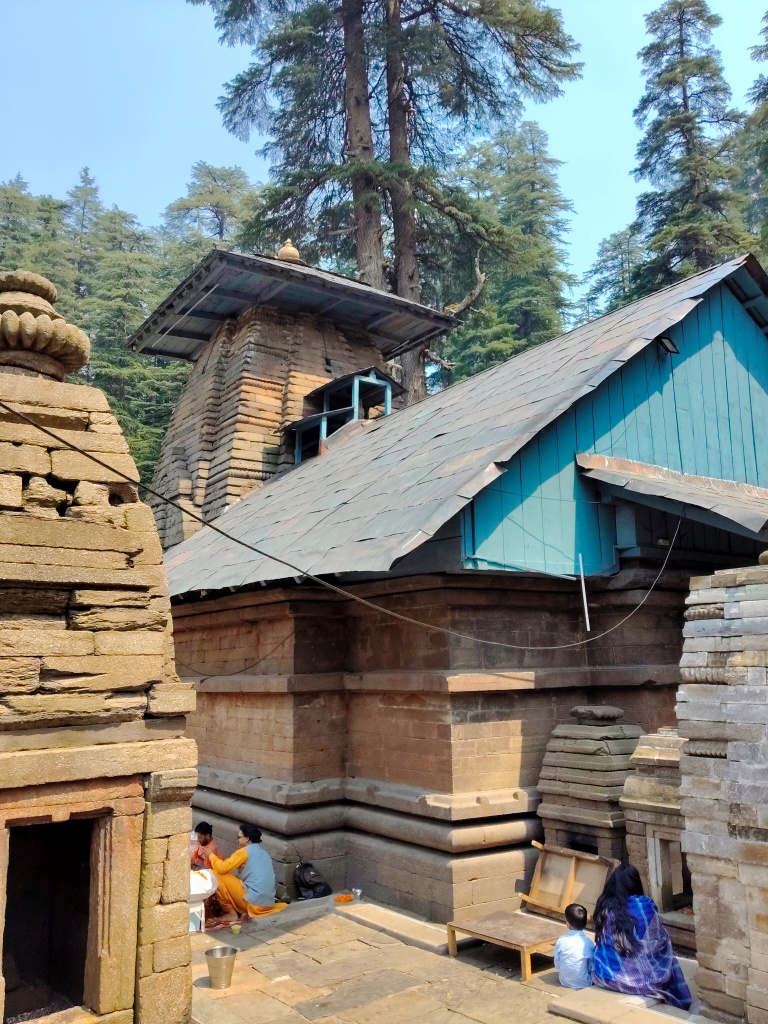
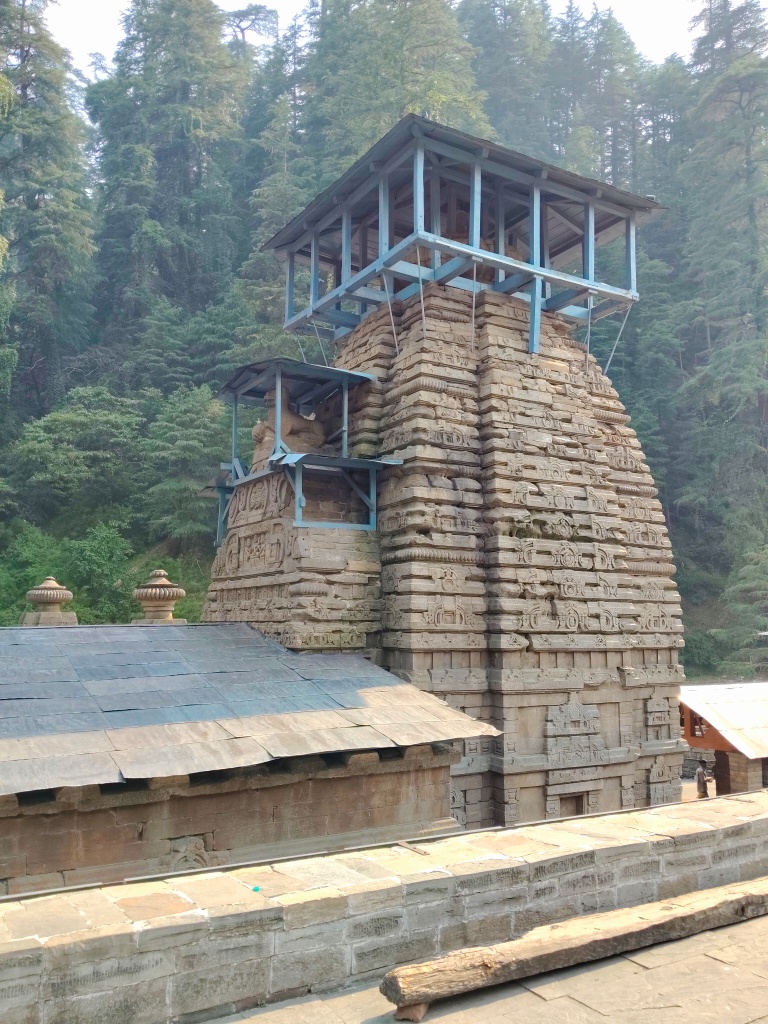
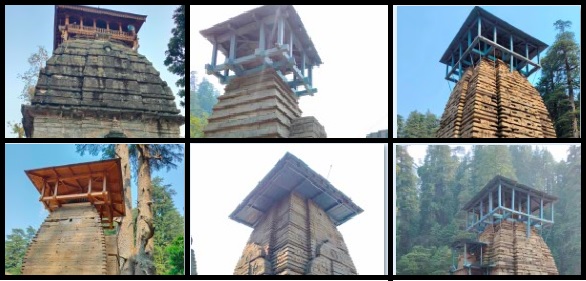
While travelling through Kumaon, I observed that many temples have their shikharas covered with wooden or tin sloping roofs. I later learned that this isn’t just an architectural feature – it is a practical adaptation to the Himalayan climate. The steep roofs allows rainwater and snow to slide off quickly, preventing water accumulation that could damage the stone walls and roof structure. The lightweight materials also offer better protection in an earthquake-prone region because it is flexible and lightweight. It is able to absorb seismic vibrations efficiently. It’s a wonderful example of how local architecture evolved in harmony with the mountains.
Temple Shikharas
Final Shared Taxi to Kathgodam
At around 3:30 PM, I began my return journey. A shared taxi brought me back to Almora by 5:00 PM, from where I boarded another shared vehicle to Haldwani. My original plan was to catch the Ranikhet Express, which departs around 8:50 PM and would conveniently drop me at Rudrapur, whose railway station is much closer to my home.
The evening offered three train options from Haldwani: Dehradun Express – 8:10 PM, Ranikhet Express – 8:50 PM & Bagh Express – 10:10 PM
Everything seemed perfectly planned. Until the mountains had different ideas.
When Traffic has the Final Say
Just before reaching Kathgodam, our cab got stuck in a massive traffic jam, completely ruining my plan of catching the Ranikhet Express. Fortunately, I still managed to reach Kathgodam just 5 minutes left for departure of Bagh Express. Sometimes, flexibility becomes the most important travel skill in the Himalayas.
Back Home
The Bagh Express reached Rudrapur right on schedule at around 11:30 PM. As I walked out of the station, I couldn’t help but smile. Over three days, I had travelled almost entirely by general-class trains, local buses and shared taxis, explored Kausani, Baijnath, Bageshwar and Jageshwar, stayed in budget accommodation, enjoyed local Kumaoni food, and experienced some of Uttarakhand’s richest cultural and spiritual heritage.
Most importantly, I completed the entire trip for approximately ₹3,600, comfortably within my original budget of ₹4,000. For anyone who believes that travelling in the Himalayas requires expensive hotels and private taxis, this journey proves otherwise.
With a little planning, flexibility and a willingness to use public transport, it is entirely possible to experience the beauty of Kumaon on a modest budget. And for me, this was much more than a budget trip—it was a journey through the mountains of my own home state, discovering places I had always wanted to visit but had never found the opportunity to explore.